The story of the agency of trees. WhT trees so for humans well known. This tree to tree.
Charlot trees a brief history
440 million fungi towered over swamps
400 million years ago: Fossil records of the first tree-like plants appear, such as lycophytes, ferns, and horsetails. These types of plants did not have seeds yet, but were the first to have vascular systems, which was a big deal because that gave plants the ability to raise off the ground and form trunks and branches. Before this, all of earth’s plants had to live close to the ground, like mosses and liverworts.
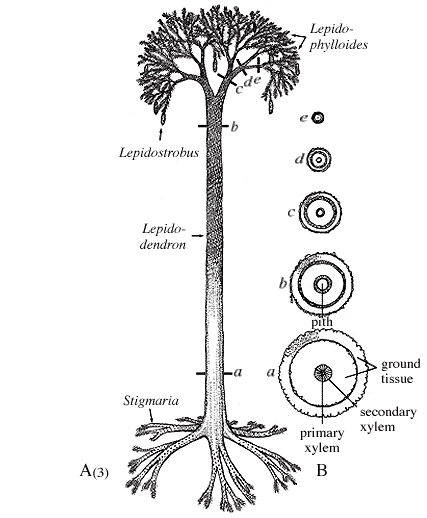
Artist interpretation of Lepidodendron, a lycophyte tree common during the Carboniferous period. Image from University of California Paleontology website
380 million years ago: First evidence of seeded plants appear. These were very simple seeds that had no integument, or layer of protection, like we seed with modern seeds.
360 million years ago: Start of the Carboniferous period and first evidence of trees with “true” woody stems. These wooden trunks helped trees achieve greater heights and also improved water transport.
Trees spread over much of earth locked down so much carbon altered atmosphere. Oxygen rocketed from 15 to 30% . Animals became huge .
360 million years ago continued: We find the first fossil records of gymnosperms during this period. Gymnosperms are seeded plants in which their seeds are not protected by an ovary (or fruit). We have many species of gymnosperm today, including conifers (pines, junipers, spruce, etc.), ginkgoes, and cycads.
200 million years ago: Evidence of the first ginkgo trees.
150 million years ago: Evidence of the first pine trees.
125 million year ago: Angiosperms began to evolve, meaning we see the first flowers on earth! Angiosperms are plants that grow flowers and hold their seeds in a protective “ovary,” aka fruit. Earth at this time was much warmer and covered with rainforest, which diversified the angiosperm group dramatically. That’s why the majority of tree species we have around today are angiosperms. With the evolution of angiosperms, we also get the evolution of pollinators like bees, butterflies, and hummingbirds.
67 million years: Evidence of the first maple trees.
56 million years ago: Evidence of the first oak trees.
Fast forward several million years and trees continued to diversity and evolve into the trees we see today. Some go extinct, some improve, some stay relatively the same, and some are brought to Charlotte on wagons…
…
American oaks. Change sex. Young produce sperm. Older acorns.
Trees shaping water
Trees developed into trees to gain power over water. Trees as rainmakers, growing tall interrupting air flows, emitting volatile organic compounds to seed clouds , releasing water vapour . Below ground roots harvest water
Gymnosperms – naked seeds. Pines firs larch. Yew, redwoods. Asteroid hit. their leaves big enough when co2 levels high, now small, veins bringing water to rudimentary, thei long life a disadvantage.
Angiosperms – flowering oak ash . More flexible
A single tree can give off a thousand litres of water a day


