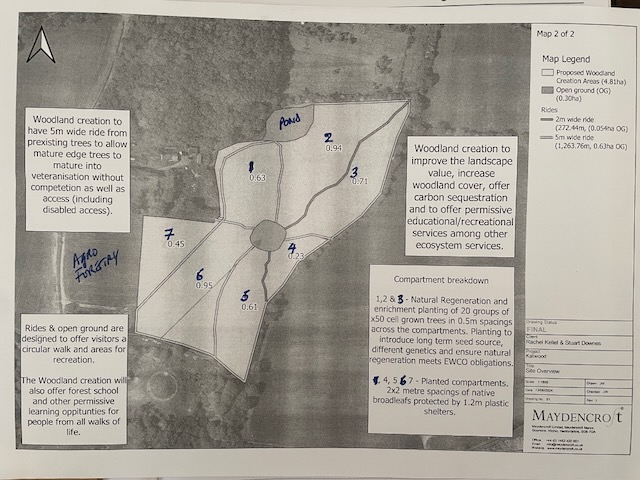
The 17 acres of land applied for Forestry Commission, England Woodland Creation Offer. Consultants Proposal by Maydencroft Summer 2024
Whole Site Hectars 6.87966 (17 Acres) entire site
1.2 Part Agroforestry /
5.43 Hectars Part EWCO (England Woodland Creation Offer)
80% Wood, 20% open ground
3 meter planting, 6 meter rides
Species type
Ecological Site Classification (ESC) for selecting tree species that are ecologically suited to particular sites. TM406776.

| 1/2/3 Enrichment planting North | ||
| Oak | 25 | |
| Hornbeam | 25 | |
| Wild Cherry | 25 | |
| Field Maple | 25 | |
| Compartment 4 East) 0.23 hectars | ||
| Silver Birch | 30 | |
| Small Leaf Lime | 30 | 20 |
| Wild Cherry | 20 | |
| Italian Alder | 20 | |
| Compartment 5+6 (SouthEast) 1.8 Hectars | ||
| Silver Birch | 10 | |
| Wild Cherry | 10 | |
| Common Hazel | 10 | |
| Field Maple | 10 | |
| Wild Service Tree | 10 | |
| Hornbeam | 10 | |
| Oak | 10 | |
| Sweet Chestnut | 10 | |
| Rowan | 10 | |
| Scots Pine | 10 | |
| Holly/Yew | ||
| Wild Pear | ||
| Wayfaring Tree | Viburnum lantana | |
| Compartment 7 West 0.45 hectars | ||
| Oak | 10 | |
| Hornbeam | 10 | |
| Wild Cherry | 10 | |
| Silver Birch | 10 | |
| Walnut | 5 | |
| Dog wood | 5 | |
| Wild Pear | 10 | |
| Crab apple | 10 | |
| Rowan | 20 | |
| Wild Plum | 5 |
Section 7 Kaliwood Tree Nursery
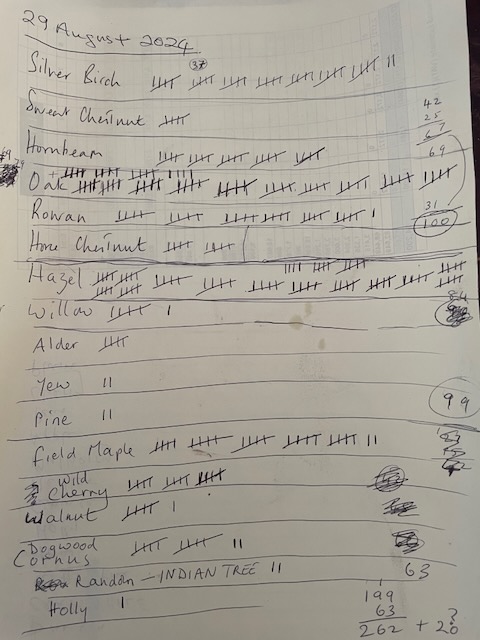
A total of 300 young trees + 400 from Woodland Trust + 300 Suffolk Tree wardens = 1,000 trees provided.
2025/26 Specialist trees
Brompton Cemetery replanting after holm oak death
Pinus greggii
Climate change is already felt acutely in central London; our dry, disturbed soils, hard surfacing and restricted rooting areas intensify the challenge. Existing Tilia tomentosa ‘Petiolaris’, Pinus radiata and Pinus nigra cope well, but we are looking more widely at pines suited to heat and drought, including Pinus greggii, P. halepensis, P. pinea and P. nigra.
Smaller, resilient species also have an important role. Crataegus tanacetifolia, the tansy-leaved thorn from Turkey, offers felted foliage, striking flowers, edible fruit and low maintenance. The cemetery’s unusual group of Platycladus orientalis is another asset: small, evergreen, slow-growing and tough, it suits restricted planting sites and may be propagated from seed, cuttings or grafting.
Unusual species include Aesculus californica, with fragrant flowers and finely toothed leaves; Polylepis australis, whose dramatically peeling bark has earned it the nickname ‘filo pastry tree’; and Firmiana simplex, with bold palmate foliage and scented flowers. Other ornamental choices include Cupressus cashmeriana, Sequoiadendron giganteum ‘Pendula’, Tetradium daniellii, Meliosma veitchiorum and Heptacodium miconioides.Sorbus torminalis, Crataegus, Malus and Pyrus will be used in a mix of native and non-native species. Later-flowering trees such as Tetradium daniellii and Heptacodium miconioides add both beauty and ecological value.

