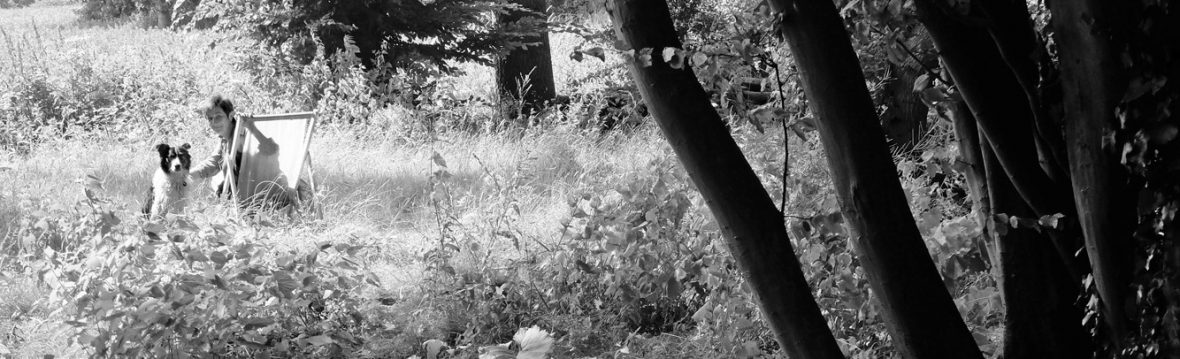
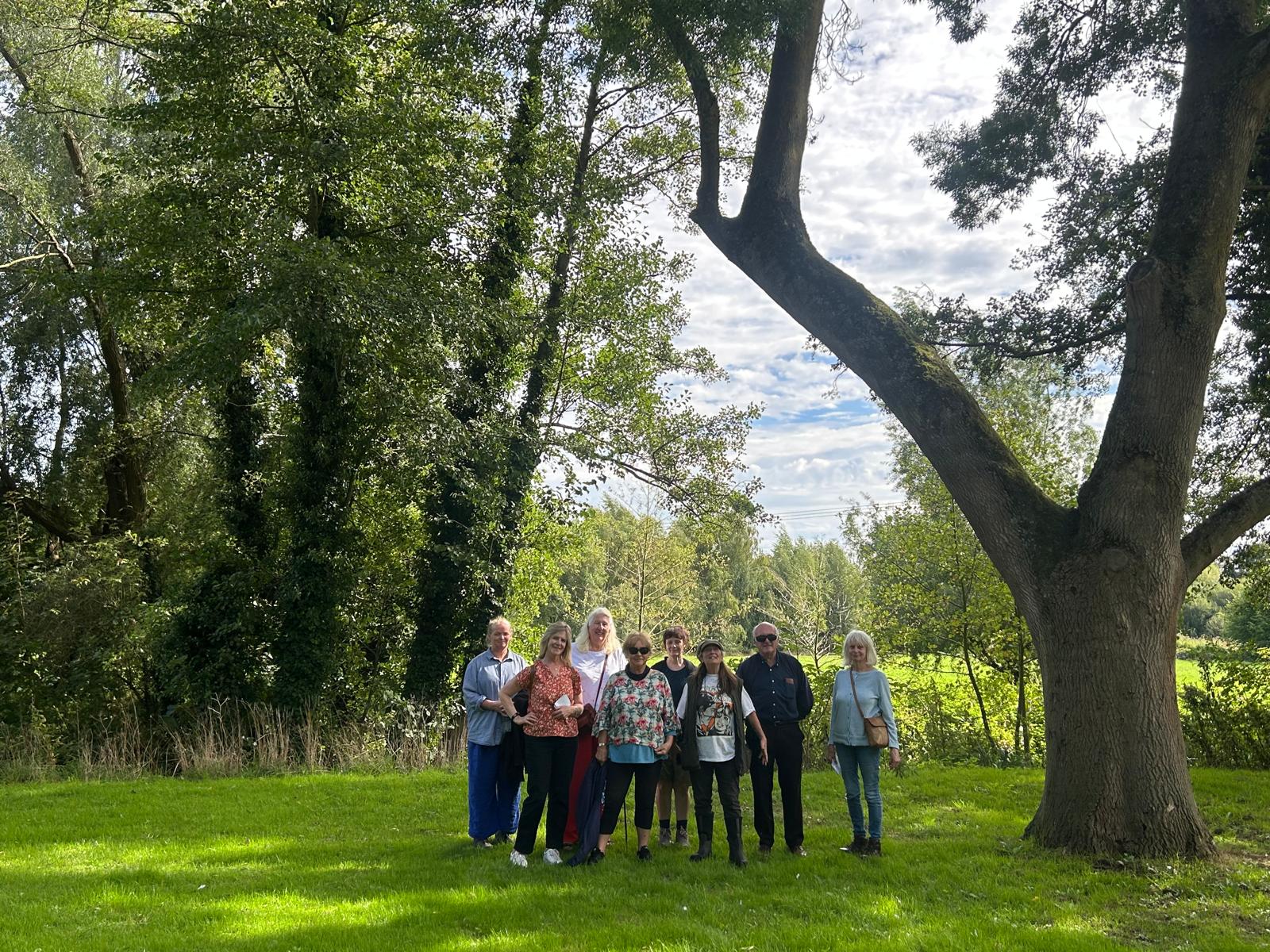
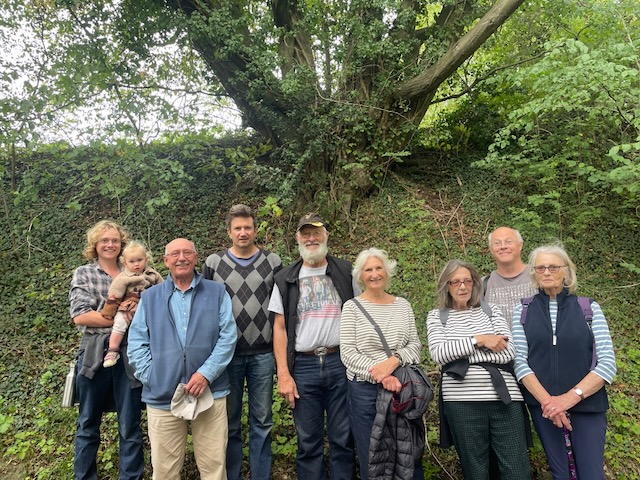
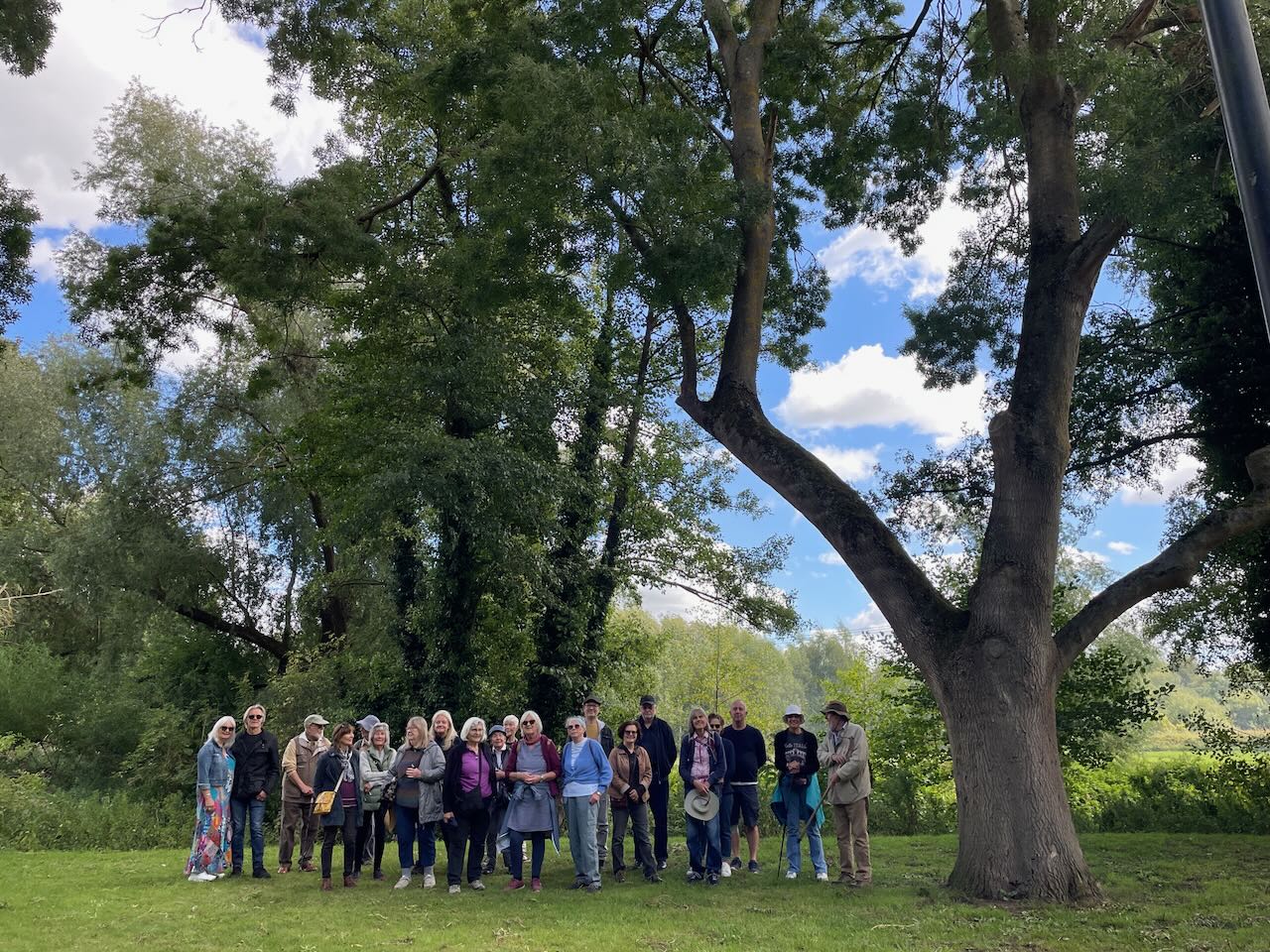
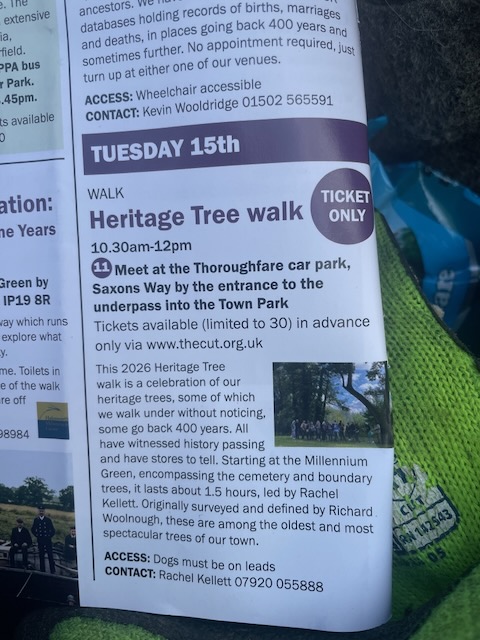
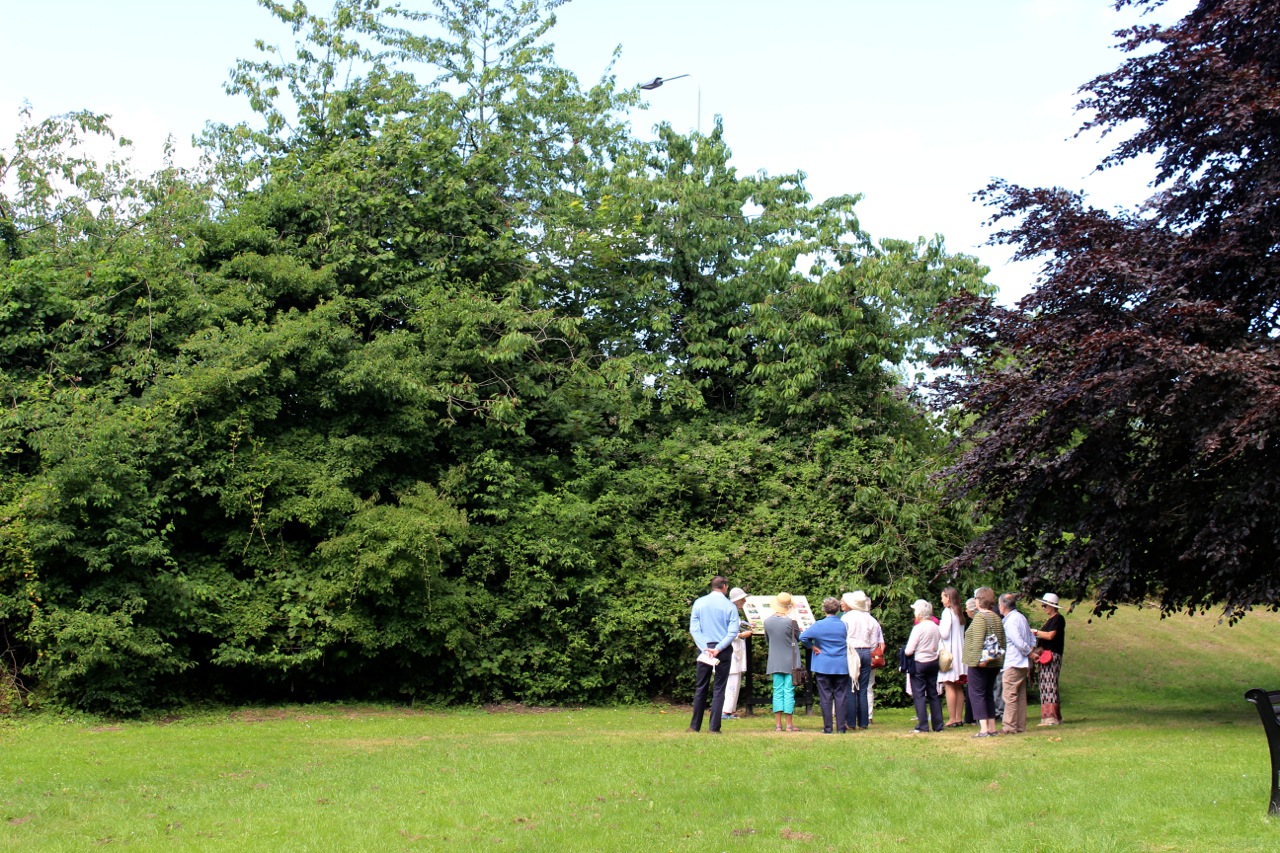
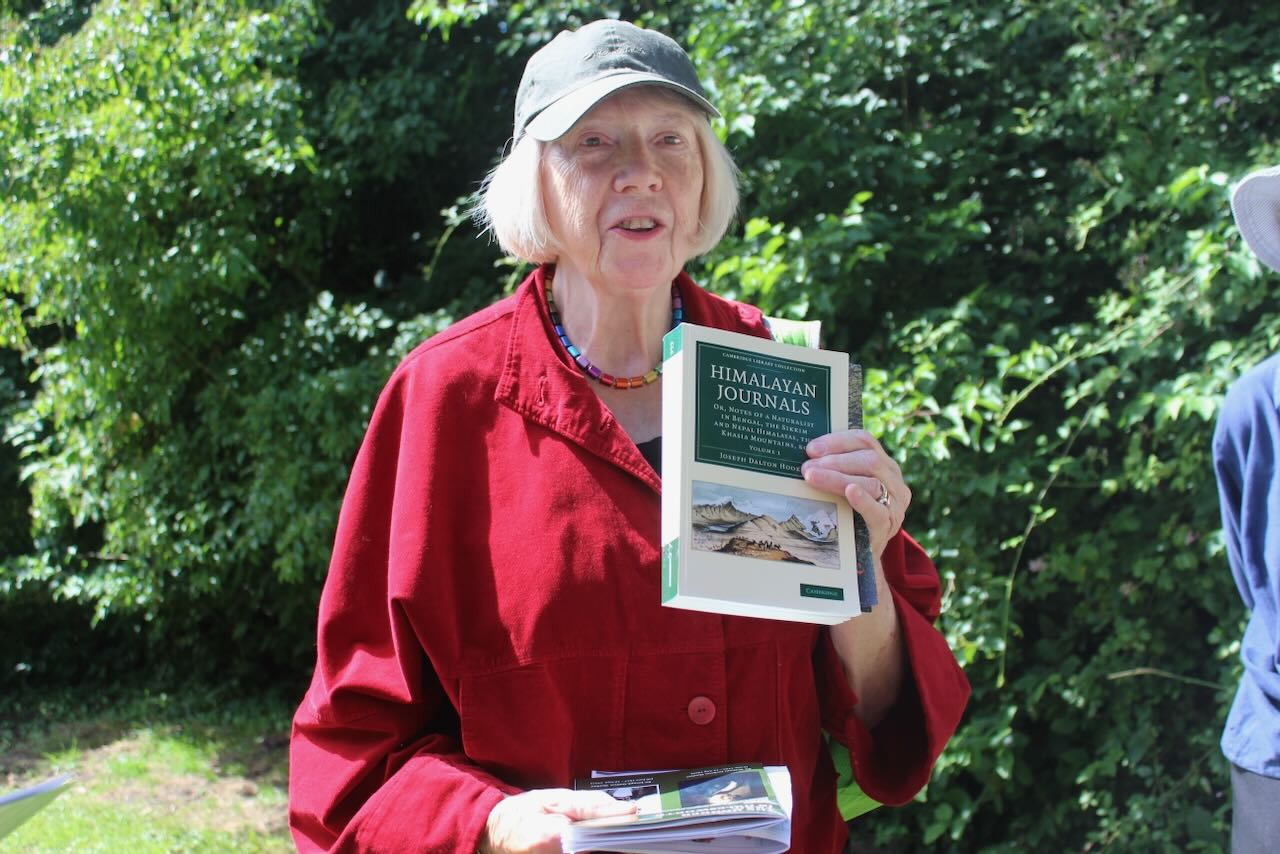
‘Imagine you’re in an C18th painting’ were the instructions to the group who came on the Heritage Tree Walk, September 2025. Here’s the small but perfectly formed group of this years first heritage tree walk.
Begun in 2019, these walks are part and parcel of our Heritage Tree data set, which not only documents our existing venerable trees, but also our trees of some note, our memorial trees and our new planting. This record allows us various advantages:
Being part of our Neighborhood Plan, they are offered some protection (along with TPO and Conservation Area protection)
This offers a baseline of what exists today in Halesworth, which can be measured yearly.
These 100 trees are annually inspected, for health and disease. If dead replaced with 2 or more
Over 5-10 years we will see what we have planted to increase our biome canopy cover
As part and parcel of the Heritage Open Days this raises the importance of a tree to the status of a Georgian House. Trees that we never looked at before are seen. Their stories and histories are explored. Trees that allow us to live by filtering our carbon di oxide and giving us oxygen. Trees that are the sequestors of carbon and essential to combat climate change.
Theme this year of 2026 is drought and survival
Halesworth Heritage Trees were first defined by Richard Woolnaugh and Halesworth in Bloom in 2012. A revised and full list and mapping of our Heritage Trees defined in 2026 and will be published end of the year as part of Halesworth Town Council Heritage Tree project.
The Google Map of Halesworth Heritage and Protected Trees 2025 is here
Halesworth Heritage and Protected tree photographs here
The Government Heritage Trees Bill [HL] private members bill is here
Wenhaston Heritage Tree report (2023) compiled by Alan Miller is here
The book I recomended on the walk was Oliver Rackham The History of the Countryside, published 1976, still relevant, and very readable.
This 2025 Heritage Tree walk is based around our first Heritage Tree walk, part of Halesworth Heritage Open Days, in 2019.
Why this walk?
For 12 years (2025) I’ve owned a 5 acre woodland in Holton, Kaliwood. (Before that I’d sat under Bodhi trees in India, and driven to Tumbukoo through groves of Baobabs in West Africa). Within all these experiences I came across people who wanted to cut down trees: to make way for mountain roads for quick access for emergency services, for firewood to cook on, to give more light, to prevent untidy leaves falling on lawns, to stop the noise of conquers falling on a roof, to stop providing perches for birds to loiter on and shit on cars. In many cases the tree could be lifted rather than felled and solutions could be found which saved the tree. Yes, their roots do get into drains, their leaves do block light. But think of all they do for us, just imagine life without them.
This walk enables us to elevate and see trees. Every tree enables our heritage. Quite simply the tree takes our waste, and turns it into our life force, carbon dioxide into oxygen (as well as the thousands of other things it does for our land, water and animals providing bed and breakfast and homes to thousands of creatures and plants and fungi).
Richard Woolnaugh, Halesworth in Bloom and HERITAGE TREES
Recorded in Richard Woolnaugh’s Heritage Trees were 31 trees, photographed, located, circumference measured, landowner listed, dated (back to 2008) and name of surveyor. I visited Richard just before he died, and he passed the book on to me, encouraging it’s continuation.
It probably grew out of the nationwide hedgerow survey. It was a start and I was hoping it would stimulate and encourage others to contribute towards it. … Don’t forget the view! Plant a tree is a very convincing sound bite – but where to plant and how to maintain? Richard Woolnaugh, 2019
TERMS of reference – What are Heritage Trees?
A heritage tree is typically a large, individual tree with unique value, which is considered irreplaceable. While it is not necessarily ancient, the major criteria for heritage tree designation are age, rarity, and size, as well as aesthetic, botanical, ecological, and historical value. Typically these trees are found where they have been protected from the ravages of mankind and our rapacious needs for habitation expansion. They are often found in our native woodlands, historic park lands including cemeteries and estates, along roadsides in particular boundaries, along railways and in hedgerows, agricultural fields and very occasionally as isolated specimens in the middle of housing estates or development sites.
The Tree Council, in 2004, commissioned a project of recording and compiling a book of Britain’s Heritage Trees, thereby “advocating a system that will specifically safeguard heritage trees for future generations”. This year 2025, I visited some of those trees on my way down to Cornwall and it was a great adventure to find these magnificent giants – the story here.
1. TOWN PARK, Hooker and the tentacles of Tamsyn
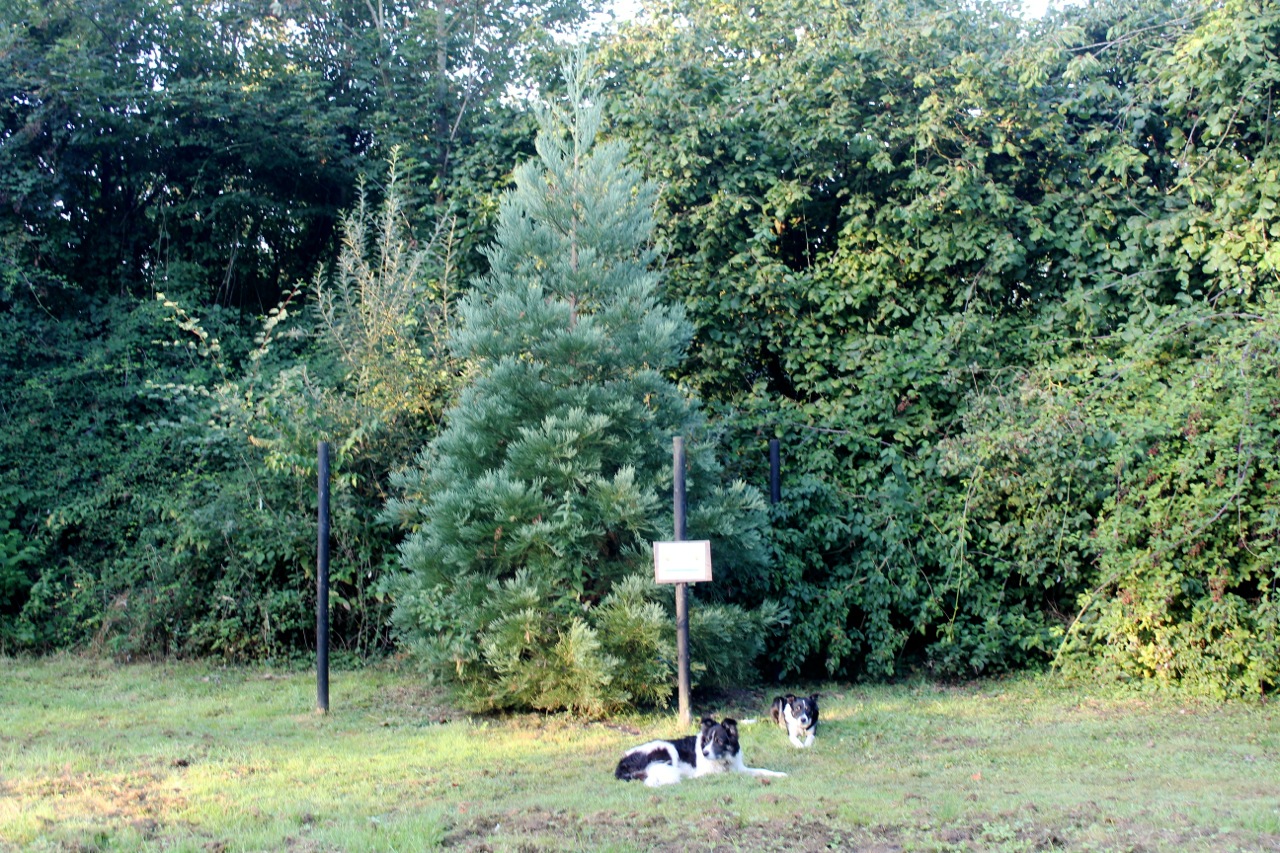
This time of year, in 2017 Tamsyn Imison led a Hooker trail walk starting at the Town Park, which was once an extension of Hooker’s own garden. A creative, energetic and inspirational woman, Tamsyn organised the planting of our future Heritage Trees in our Town Park, namely a Giant Redwood and a Magnolia Grandiflora, both connected to the Hooker family. We started our walk here, admiring the rapid growth of the Giant Redwood, which had doubled in size in the two years since planting. Tamsyn and Hooker were both admirable and successful activists.
Below Tamsyn Imison shortly after planting the Sequoia. It is about 8 foot tall here, in 2018.
Above Tamsyn Imison. Below the Sequoia in 2019. Dogs for size.
The Giant Redwood Sequoiadendron giganteum and Activism
The fact that the timber is of little use did not stop the European settlers in California from setting up saw-mills and cutting millions of feet of lumber. In 1878, Sir Joseph Hooker, Director of the Royal Botanic Garden Kew, prophesized widespread felling would drive the giant redwood to extinction before 1900. Giant redwood would then have the sad distinction of having been discovered by Europeans and destroyed by Europeans in the same century. The fact that the species is not extinct is due to the efforts of men like American Frederick Law Olmstead (co-designer of Central Park in Manhattan) and Scotsman John Muir. The latter was born in Dunbar in 1838 but emigrated to America with his family at the age of 11. It is thought that it was Muir who convinced Hooker, and many others of the plight of the Pacific forests and their inhabitants. Some historians credit him with being the real force behind the establishment of national parks in the USA.
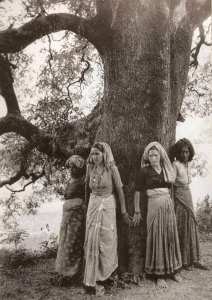
Activism and Trees have a long entwined history There are the tree huggers of India, the Chipko movement. Closer to home In January 1996 an army of eco warriors took to the trees in Newbury to try to prevent the construction of the Newbury bypass. The road was eventually built, but 20 years on did the “Battle of Newbury” have a lasting impact? 10,000 trees were eventually cut down to make way for the road that would get rid of a notorious bottleneck on the A34. (https://www.bbc.co.uk/news/uk-england-berkshire-35132815) Closer to home over 25,000 trees have recently been felled to build the new Sizewell C power station
ASH MAIDEN and ASH COPPICE and ASH POLLARD and ASH DIEBACK and Caucasian Ash – Fraxinus oxycarpa
Beside the skate park are 3 splendid and healthy Ash trees, which must have been planted deliberately as a grove. They are startlingly healthy with little sign of the relatively new tree disease of Ash Die Back. These are Caucasian or European Ash – Fraxinus oxycarpa, distinct but related species of Ash tree. It has narrower leaves and is known for its tough, shock-resistant wood used in sports equipment and tool handles.
As Ash Die Back began to shake us all, Oliver Rackham wrote a beautiful little book just on the Ash Tree. Ash Die Back is caused by the fungus Hymenoscyphus fraxineus (previously known by the names Chalara fraxinea and Hymenoschyphus pseudoalbidus). It blocks the water transport systems in trees causing leaf loss, lesions in the wood and on the bark and ultimately the dieback of the crown of the tree. This disease was first described in Poland in 1992 and has since swept westwards throughout Europe, sadly now wide spread in the UK mainly caused by the free import of Ash stock from East Europe, a madness as Ash seeds like weeds on our land.
These two Caucasian Ash are my favourite trees of all Halesworth. They make me think of C18th paintings
The THREE BEECHES and a DUNWICH ROSE
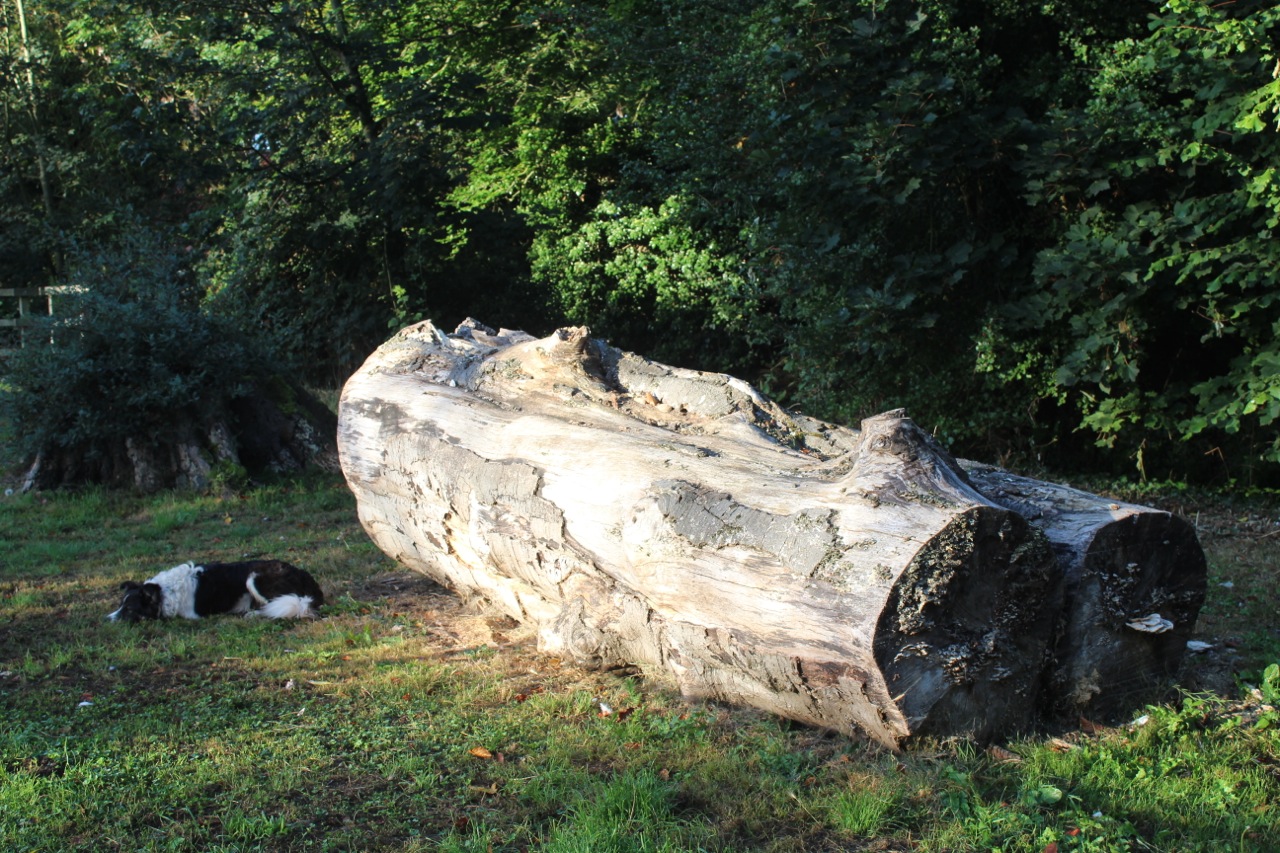
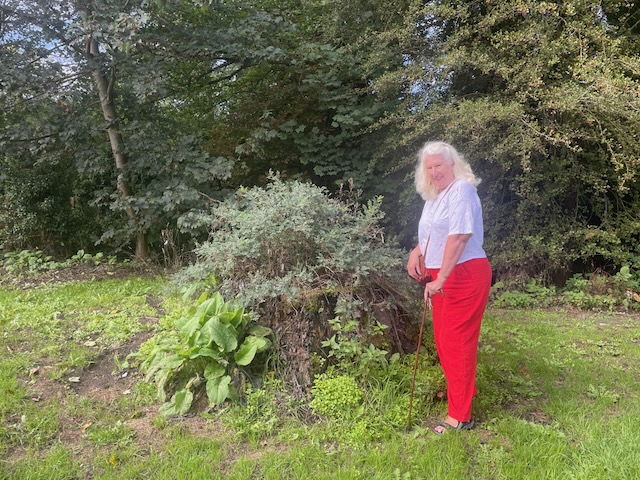
There were three Beech trees here, two on the Town Park side of the river and one in the garden of Mayfied Lodge. The eastern tree blew down and soon after the western tree developed an ominous crack and the lean increased. It was felled by Waveney DC on safety grounds. Soon after the great hollow of the beach was vandalised and set alight so a very thorny Dunwich rose was planted in the centre by and is maintained by HIB.
Neil Mahler, a fungi expert from Leiston, was with us to diagnose the fungi as Meripilus giganteus (Giant Polypore) which would have been the reason the tree was felled.
We were lucky to have with us this year the planter of the thorny Dunwich Rose, Linda Grey – here she is in not a very clear photograph.
HORSE CHESTNUT
On the Millennium parkland and owned by the Millennium Trust set up by Richard Woolnough, this splendid parkland tree stands alone in the meadow, now named after the tree – Chestnut Meadow.
Adjacent to the Town River and originally established as an ox bow where it was protected from grazing. When the river was straightened ie canalised, and the Blyth Navigation was constructed and with it the ‘New Reach’, what remained of the river was left in the field and formed an ox bow. “The river naturally formed this shape, the closed up U, like the bow put around neck of an ox or bullock. After the war everything was done to grow food. Fields straightened and combined, hedgerows came down. The river was straightened, just a line across the narrow point. There is a shadow on the green of it’s old passage. Rivers like to meander, and this and other changes meant our river dropped by 5 feet – it used to be as flowing as the Bungay Waveney. The Chestnut survived to represent the tale.”
SWAN LANE OAK POLLARD
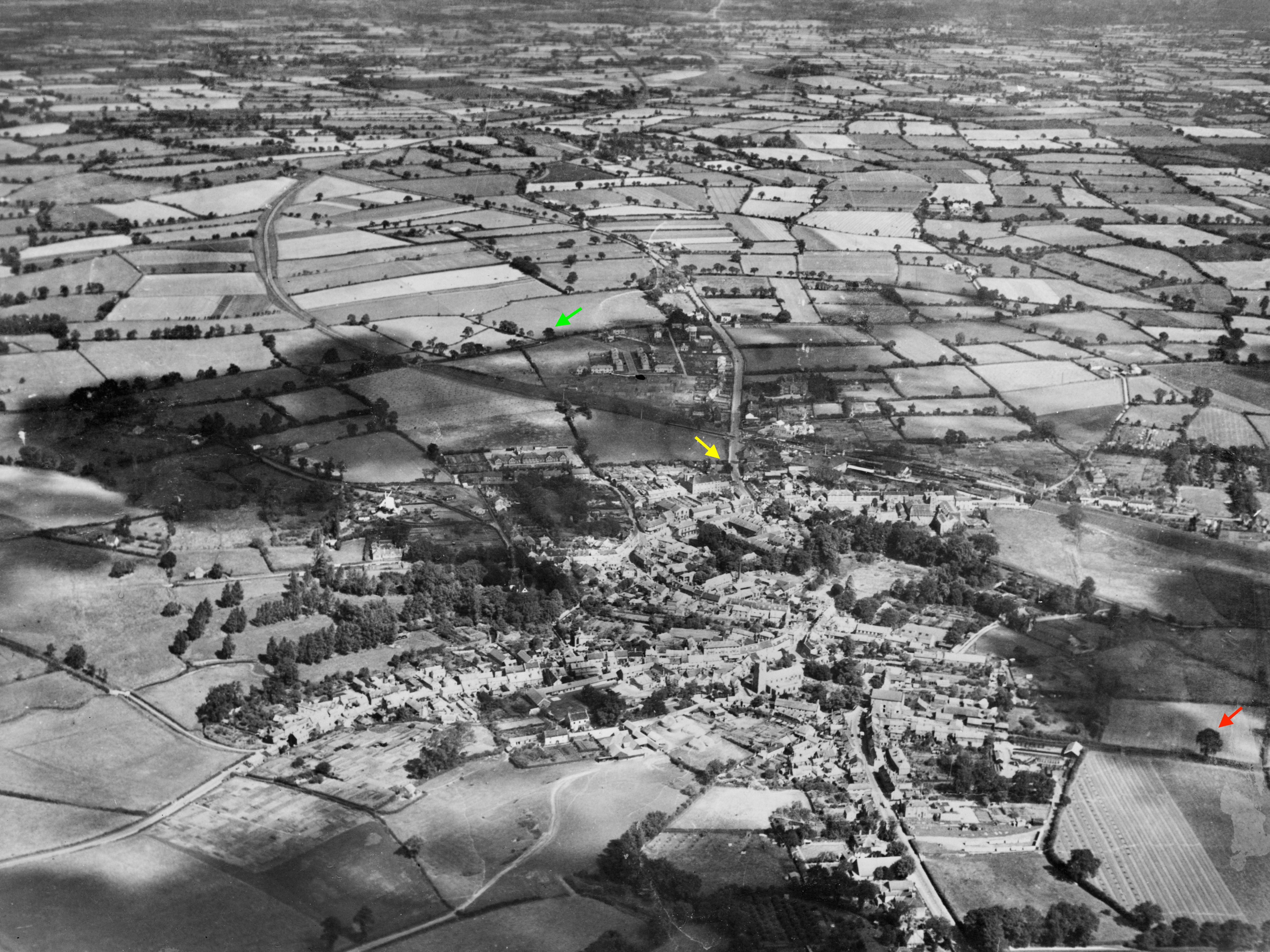
The Swan Lane Oak Pollard is one of 4 Halesworth Verteran Heritage Trees. It is magnificent to find, amid a housing estate. There must have been a person or people who fought for leaving it. It is a classic oak pollard in very good condition. A few branches overhanging the alotments have been pruned. Its circumference is 4.6 meters, which makes it approximately 362 years old.
Thanks to Jamie MacDonald for this 1935 aerial photograph of Halesworth – with the Swan Lane oak marked in a red arrow
WILLOWS
Willow, crack (Salix fragilis) is the most common willow on the Millenium Green, and the largest growing, easily ‘cracking’, the sound made when its branches and twigs fall, which they often do. Because the trees often grow beside rivers, any twigs that break off are carried downstream. This helps the trees propagate themselves, as the branches take root easily and may end up some distance away from where they fell. Goat Willow (Salix caprea) has smaller rounder leaves and attractive puffy catkins. Sometimes known as great sallow Grey Willow (Salix cinerea subsp. oleifolia). Small sallow Pussy Willow (Salix discolor) Weeping Willow (Salix babylonica) Bebb Willow (Salix bebbiana) Corkscrew Willow (Salix matsudana ‘Tortusa’) Narrowleaf Willow (Salix exigua)
Multi Stemmed Alder / Oak with bat box / Oak with Owl Box / Black Poplar
These handsome trees, all further up the Millennium Green, are listed as some of our 100 heritage trees, and worth a visit another time.
2. CEMETERY
LIME TREES – in front of the Fire Station
Lime, small-leaved (Tilia cordata) and Lime, common (Tilia x europaea). The Lime has Long been associated with fertility. Lime wood is soft and light, white-yellow and finely textured. It is easy to work and often used in turnery, carving and furniture making. The wood does not warp and is still used today to make sounding boards and piano keys. Limes can be coppiced and used for fuel, hop-poles, bean-sticks, cups, ladles, bowls and even Morris dancing sticks. They are fine trees in a changing climate, offering substantial shade.
Halesworth Burrial Board was formed in 1884 and Holton Road Cemetery opened in January 1855 at a cost of £1,000. It was extended in 1896 and covers 3 acres. The oldest headstone found is that of Elizabeth Took who died 1857. The old section at the entrance has a chapel on the left (see above) used by the Anglicans and they were also buried on the left. The chapel on the right was used by Non Conformists and they were buried on the right on unconsecrated ground.
The drought friendly white gardens were created with sponsorship from an anonymous donor, and is maintained by HIB.
A frequently trimmed Giant Sequoia is sometimes known as Wellingtonia -John Lindley of the Horticultural Society, was assigned the task of naming the introduction, opted for the decidedly un-American ‘Wellingtonia gigantea’ to commemorate the lately deceased Duke of Wellington
Janet’s notes: Halesworth Burial Board Minute Book 1955
12 November 1898 Mr Ritlow met Lord Suffields Head Gardener, Ipswich to discuss planting. Trees planted at intervals along fences, clumps of trees and shurbs at each of NE and NW corners. Alongside each side of cross and centre paths to be planted small dark yew or fir trees about 4 ft high and 18 to 24 inches in diameter. Rough Estimate 500 trees and shrubs of various kinds @15/- to 20/- per hundred £5.00.00 Carriage £1.00.00 Cutting down old fence and making new £12.10.00 Altering ditch £2.10.00 Labour planting shrubs £5.00.00 Total £33.00.00
HOLM OAK (Quercus ilex)
Holm Oak, native to the Eastern Mediterranean, was introduced to Britain in the late 1500s. Like the Sessile oak, the female flowers develop into acorns, smaller and more pointed tip. Trees are resistant to salt-spray from the sea, and are often planted as a windbreak in coastal situations. (Typically the avenue at Holkam Norfolk). Holm oak is not as valuable to wildlife as native English and sessile oaks, but its catkins provide a source of pollen for bees and other insects, while its dense, evergreen canopy offers year-round shelter for birds. Holm oak timber is incredibly hard and strong. The Romans used the wood for making the wheels of carts and carriages, as well as agricultural tools. Today it is sometimes used for firewood as it is slow and long lasting. Holm oak acorns are used to feed pigs reared for Iberico ham.
The bracket on the largest Holm Oak is Ganoderma.
FOR THE LOVE OF EVERGREENS, native and foreign
How to tell the difference between PINE, FIR, SPRUCE, YEW, CYPRUS, CEDAR Without doubt, the most important information to identify is observed in the needles.
PINE – Always grow in clusters from a single origin point on a branch, are often sensually soft and tend to grow to greater lengths than other conifers.
SPRUCE – These needles tend to be short and stiff. Unlike the needles of a pine, these tend to grow from a single origin point and are attached to small, stalk-like woody projections.
FIR Needles are soft and flat. Grow from a single point of origin like a spruce, but are attached to the branch in a manner resembling a suction cup.
YEW – More easily identified because yew tends to form small shrubs, yews could be mistaken as fir tree because of their flat needles.
CYPRESS, Arborvitae, and Juniper
Cypress and arborvitae tend to develop flat, scaled needles and have rather flexible branches. Junipers have short, spiky needles.
Cedar – Needles tend to be fern-like and have a strong scent when rolled between your fingers. The needles are similar to those of pine trees, except they are much shorter.
Scots pine (Pinus sylvestris)
Scots pine is an evergreen conifer native to northern Europe, and is the only truly native pine in the UK. As the largest and longest-lived tree in the Caledonian Forest, the Scots Pine is a keystone species, forming the ‘backbone’ on which many other species depend. Scots pine is the most widely distributed conifer in the world, with a natural range that stretches from beyond the Arctic Circle in Scandinavia to southern Spain and from western Scotland to the Okhotsk Sea in eastern Siberia. It is one of the strongest softwoods available, and is widely used in the construction industry and in joinery. It is used in the manufacture of telegraph poles, pit props, gate posts and fencing. The tree can also be tapped for resin to make turpentine. Other uses include rope made from the inner bark, tar from the roots and a dye from the cones. Dry cones can be used as kindling for fires.
CEDAR of Lebanon (Cedrus libani)
Cedar was thought to represent purification and protection, and represents incorruptibility and eternal life. In the UK, cedar was planted in nearly every stately home and mansion from the 1740s onwards, however it is not commonly planted today. Today cedar is used for its hard, durable wood, which retains a sweet fragrance for many years. An oil similar to turpentine can be obtained from the wood.
Cypress, Lawson (Chamaecyparis lawsoniana)
Lawson cypress is a dioecious evergreen tree native to California. It was introduced to Britain in 1854. There are now many ornamental cultivars. Could be confused with: true cypresses (Cupressus x leylandii). The wood, which is strong and light is highly valued in Japan for coffin and shrine construction. It is also used to make arrow shafts and musical instruments, especially guitars.
YEW (Taxus baccata)
Yew has long been associated with churchyards and there are at least 500 churchyards in England which contain yew trees older than the building itself – ten yew trees in Britain are believed to predate the 10th century. It is not clear why, but it has been suggested that yew trees were planted on the graves of plague victims to protect and purify the dead, but also that graveyards were inaccessible to cows, which would die if they ate the leaves or seed.
Yew trees were used as symbols of immortality, but also seen as omens of doom. Yew trees contain the highly poisonous taxane alkaloids that have been developed as anti-cancer drugs. Eating just a few leaves can make a small child severely ill and fatalities have occurred. All parts of the tree are poisonous, with the exception of the bright red arils. The black seeds inside them should not be eaten as they contain poisonous alkaloids.
HORNBEAM COPPICE (Carpinus betulus)
On the bank above the old cemetery is a magnificent Hornbeam Coppice. The body of the tree – these September days full of papery, green winged fruits, known as samaras – can be seen on the top side of the bank. The name hornbeam comes from the hardness of its timber – ‘horn’ means ‘hard’ and ‘beam’ was the name for a tree in old English. Like beech, a hornbeam hedge will keep its leaves all year round, providing shelter, roosting, nesting and foraging opportunities for birds and small mammals.
Hornbeam is the food plant for caterpillars of a number of moth species, including the nut tree tussock. Finches and tits and small mammals eat the seeds in autumn. Traditional used for the wood included ox-yokes (a wooden beam fitted across the shoulders of an ox to enable it to pull a cart), butchers’ chopping blocks and cogs for windmills and water mills. It was also coppiced and pollarded for poles.
ASH POLLARD (Fraxinus excelsior)
Further up the Loam Pit land is an Ash Pollard and probably a boundary tree.
Cemetery hedge row and the debate of IVY – is it good or bad?
The hedgerow around the cemetery, according to Richard, is one of the most diverse hedgerows in Halesworth is around the cemetery and as you know (he says) diversity is a proxy for age.
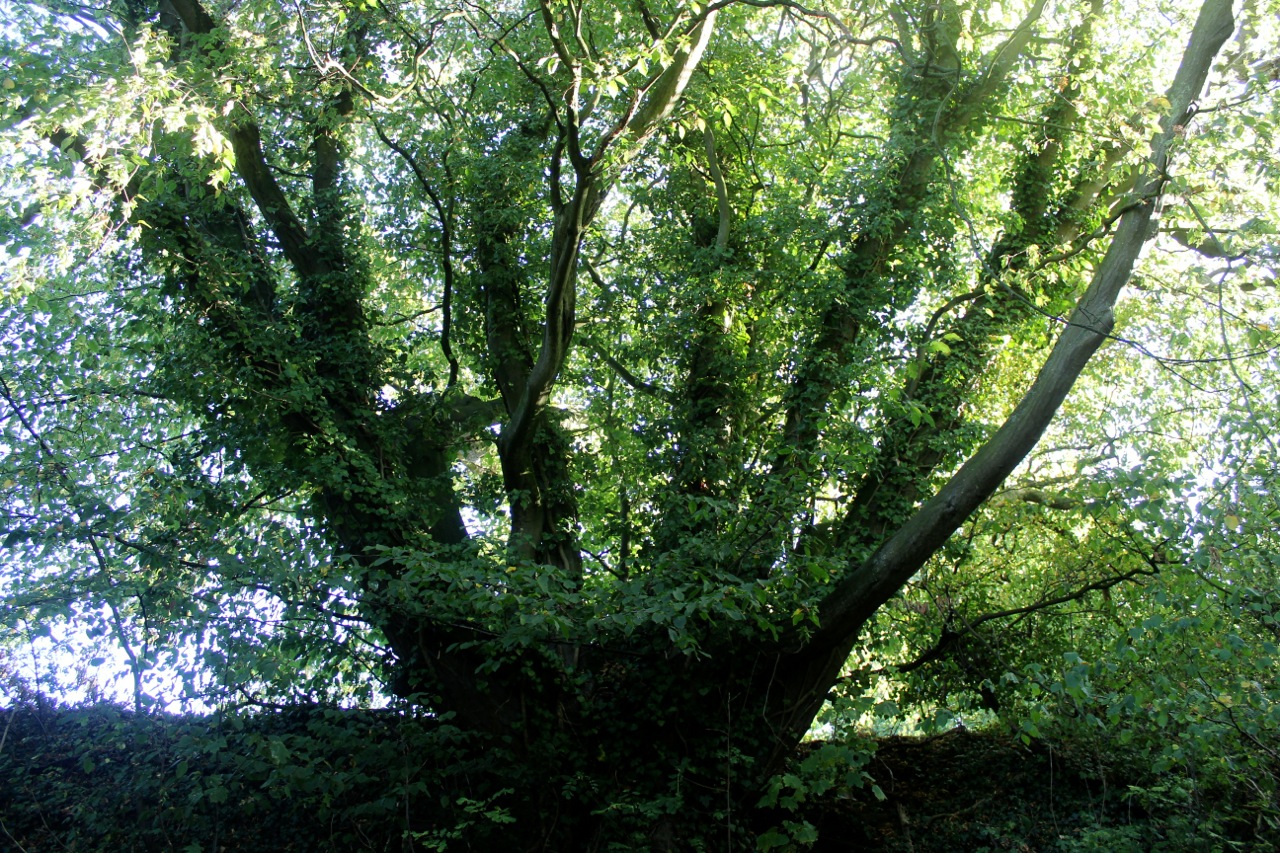
Ivy doesn’t harm trees. Ivy is not a parasite – it lays down roots, meaning it doesn’t need to take sustenance from the tree. Ivy doesn’t suffocate or strangle a tree, but simply uses it to climb up in its endeavour to reach the light. It’s an invaluable late-season nectar source. In autumn ivy has small yellow flowers, providing valuable nectar for an array of insects when few other pollinating flowers or sources of nectar are available. Wasps, hornets, hoverflies, bumblebees, small tortoiseshells, peacock butterflies and red admirals all make use of ivy’s late-season bounty. The nectar provides essential reserves needed by the adult admiral butterfly to hibernate over winter. Ivy also provides year-round shelter Ivy is the plant equivalent of a 24/7 grocery store for animals. The dark berries provide an essential food source through the harsh winter months for many birds including blackbirds, thrushes and wood pigeons. Ivy also has an additional benefit of serving as year-round ground cover. It roots at many points, with stems that cover a wide area. This notably reduces the effect of frost hardening the ground in winter months, which means animals can continue to forage in the leaf litter during bitter weather. Ivy can protect buildings. The effect of ivy on historic monuments was such a significant issue that English Heritage carried out a three-year project with Oxford University to determine the true effects of ivy growing on walls. The findings were good news for ivy-lovers: in winter ivy keeps walls 15% warmer than other parts of the building, and in summer walls were recorded to be 36% cooler. Ivy’s protective properties also preserves walls from frost, salt and pollution. As with trees, if there is any existing damage to a structure, ivy will add to the problem as it roots into cracks and crevices. So unless your walls or trees are vulnerable, there’s no need to remove ivy.
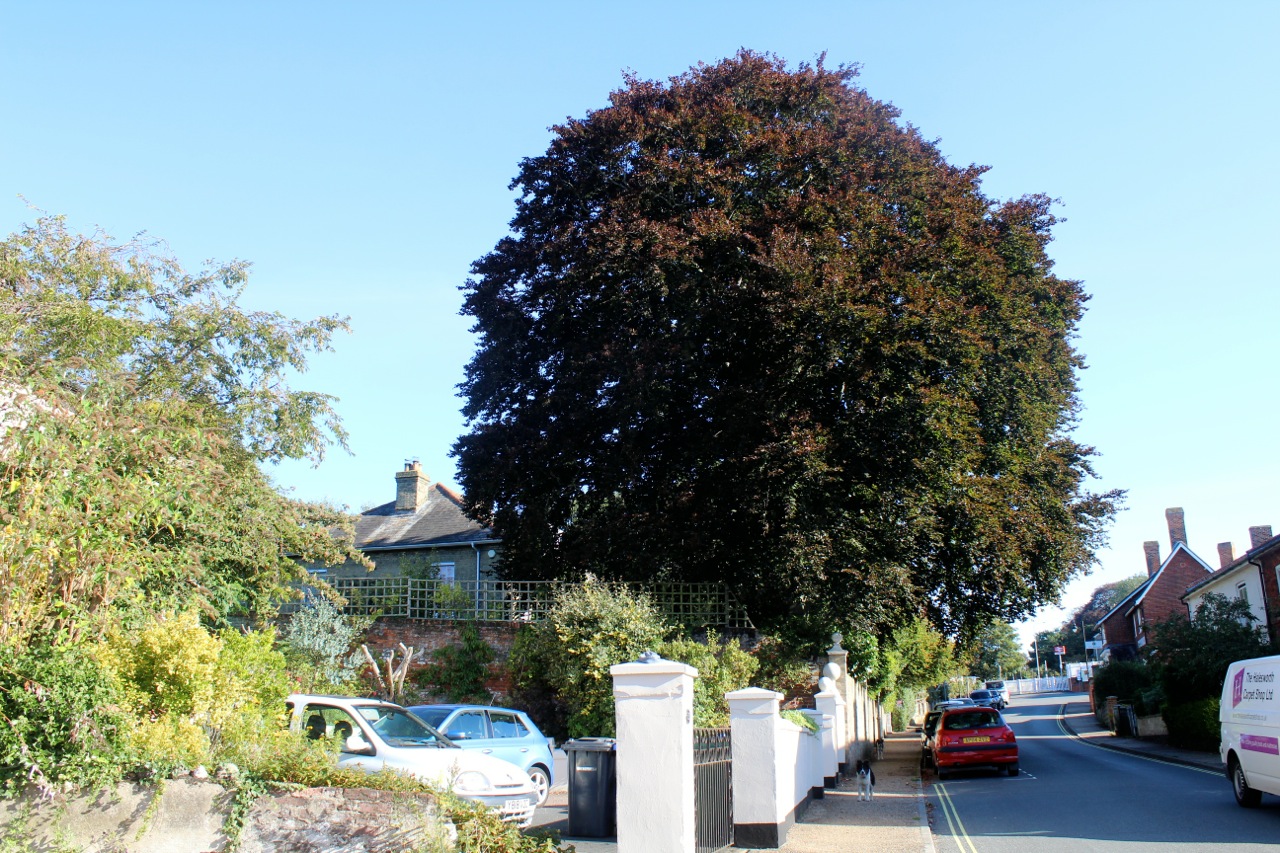
Copper BEECH (Fagus sylvatica f. purpurea) at MAGNOLIA HOUSE
We almost end our walk here in the garden of Magnolia House, a fine Georgian home, built around 1850, and probably the copper beech planted at the same time. It is a rare survivor of a specimen tree in a town garden, and dominates Station road – it is hard to imagine the road without it.
This was the home of Tamsyn Imison, so we have come full circle with our story
Copper beech, also known as purple beech, is a cultivar of common beech, and appeared as natural mutants in Europe as early as the 15th century. It is now classified as native in the south of England. As with common beech, the foliage of copper beech is eaten by the caterpillars of a number of moths, including the barred hook-tip, clay triple-lines and olive crescent. The seeds are eaten by mice, voles, squirrels and birds.
Our final end is at Hocker House, the home of Joseph Hocker who was born here and became the founder of Kew Gardens. The Hocker story was unearthed by Tamsyn and for this we have much to thank her for.
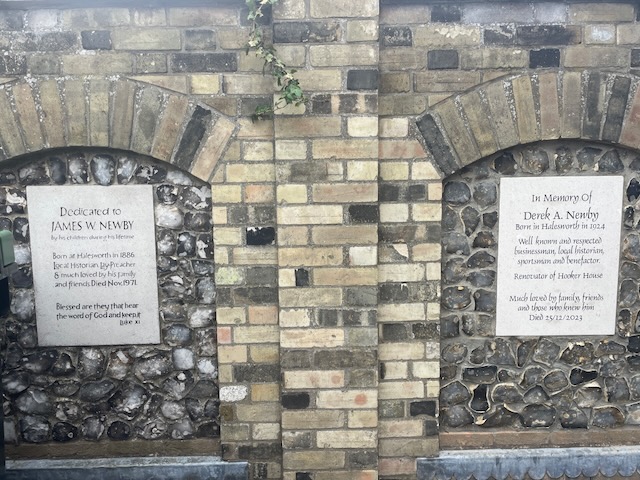
It is always a a pleasure to re-discover this walk, these trees, the cut through footpaths that I didn’t know were there, a chance to look up and notice those thees I had been walking past for some years. I always think of Richard Woolnaugh as I prepare this walk, who I thank and think of each time I walk on the path that meanders through the Millennium Green. I hadn’t noticed these dedications until this year – embedded in the flint wall beside Hocker House
Ancient Tree
An ancient tree is one that has been allowed to grow old and with great age comes great habitats for wildlife. It is in the third and final stage of its life, which is not the end of the line – even though they are in the process of dieback and decay, it may go on for a long time. Typically they have wide trunks, which will likely be hollow. It could be an old coppice or pollard, which are some of the oldest trees and impossible to date through girth. Like humans, trees shrink with age so they may have a small canopy.
Veteran Tree
A veteran tree has features associated with advanced age (for its species), having the connotation of a ‘battle-scarred survivor’. As such a veteran tree has features which increase its value as habitat for wildlife (dead wood, cavities etc.) irrespective of its chronological age.
Maiden Tree
In forestry and the survey of veteran trees, a maiden is a tree of seedling origin which has never been coppiced or pollarded.
Age of a tree
Step 1: Measure the Girth Height: Measure the trunk at breast height, which is about 1.3 to 1.5 meters (4.5 feet) above the ground.
Step 2:Find Diameter (DBH): Divide the girth (circumference) by Pi (π ≈ 3.1416). [1, 2]
Step 3Multiply by Growth Factor: Multiply the diameter by the standard growth factor assigned to that species. Common average annual growth rates (girth added per year) include:
Holly / Yew: ~1.25 cm per year Oak: ~1.88 cm per year Ash / Beech / Elm: ~2.5 cm per year Sycamore: ~2.75 cm per year Pine / Spruce: ~3.13 cm per year