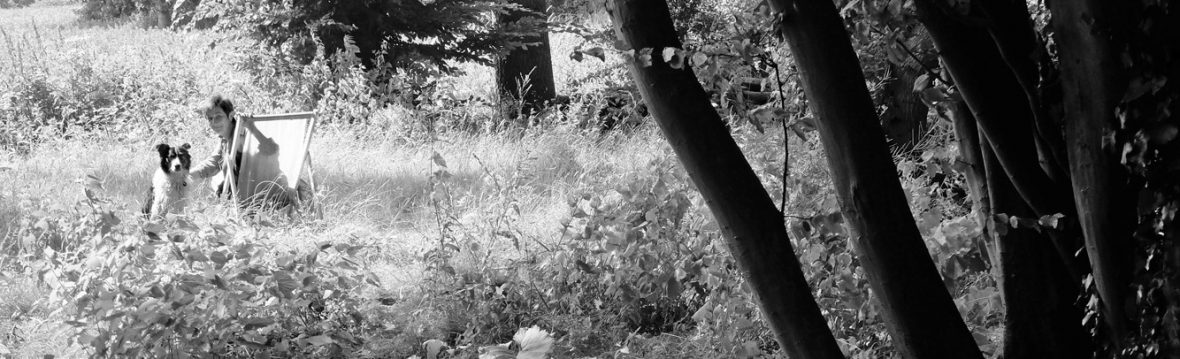
Visited late afternoon one day in July at the invitation of Nathan, who has been living on the Blyford Estate for 7 years, and hoped to live there for 70, but has to leave in 7 weeks. The landowner Miles is selling/has sold his estate. Nathan invited me before he left, to see the old Hornbeam coppice Blyford wood, as it was likely to be sold for shooting rights.
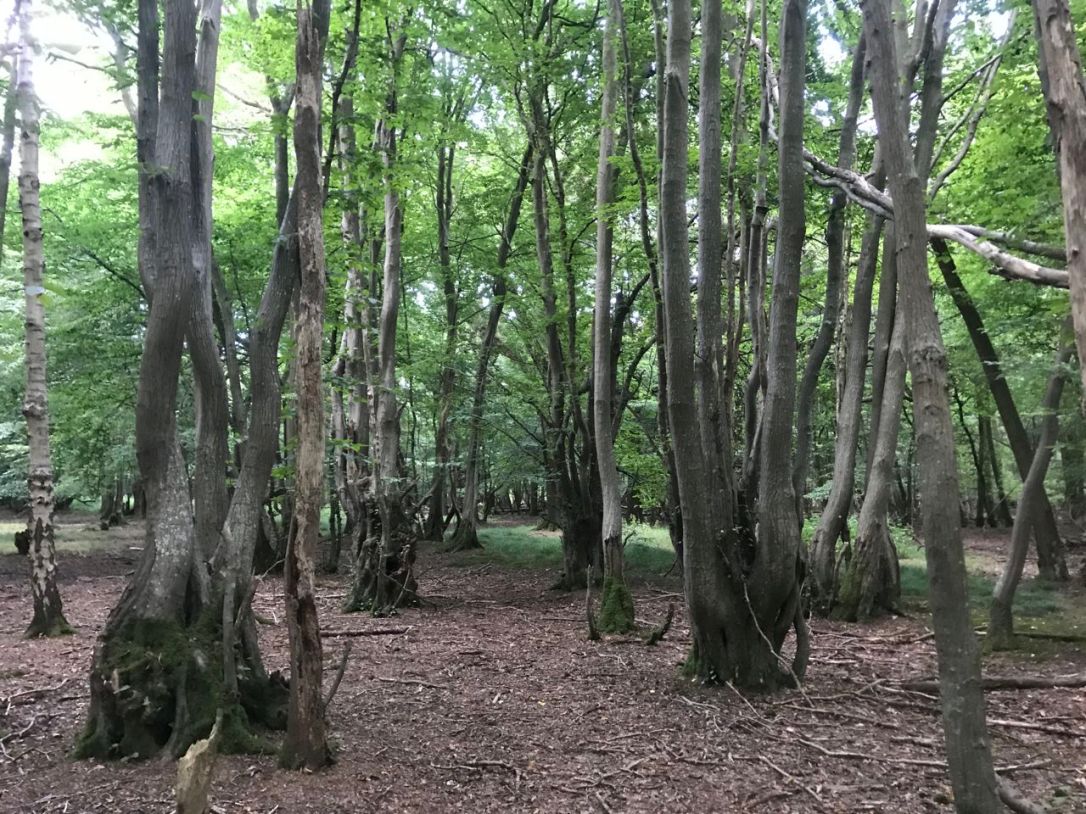
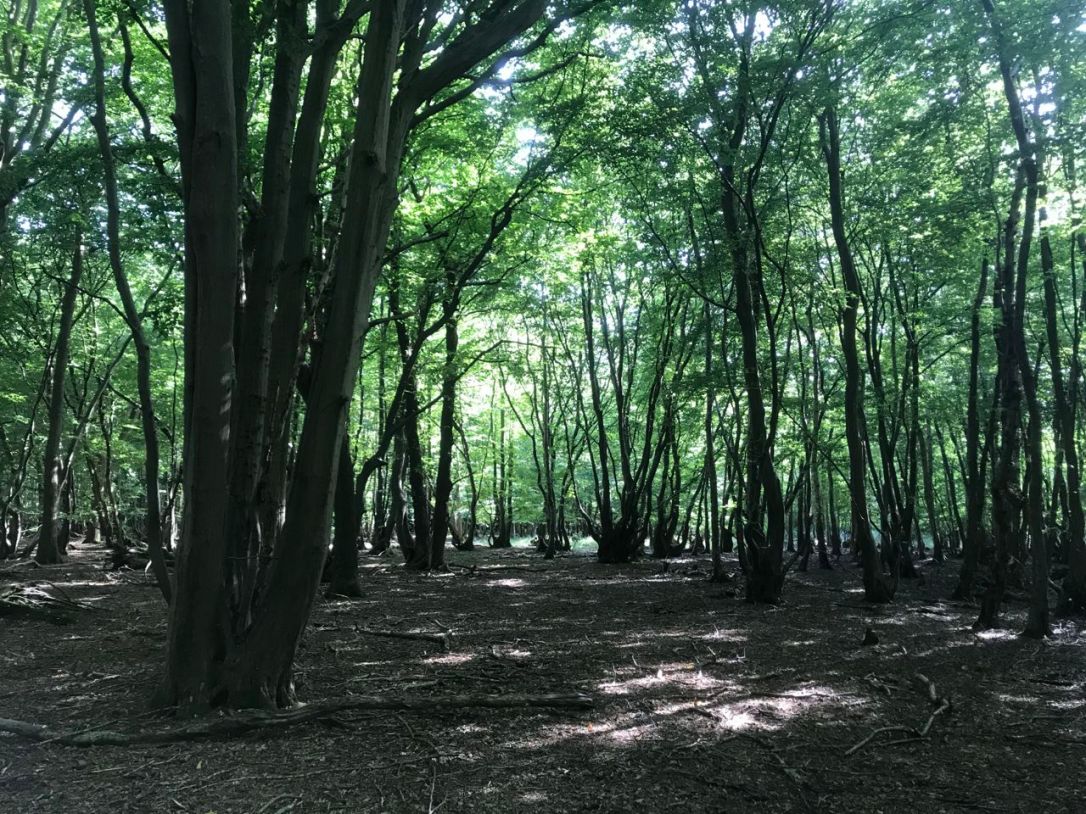
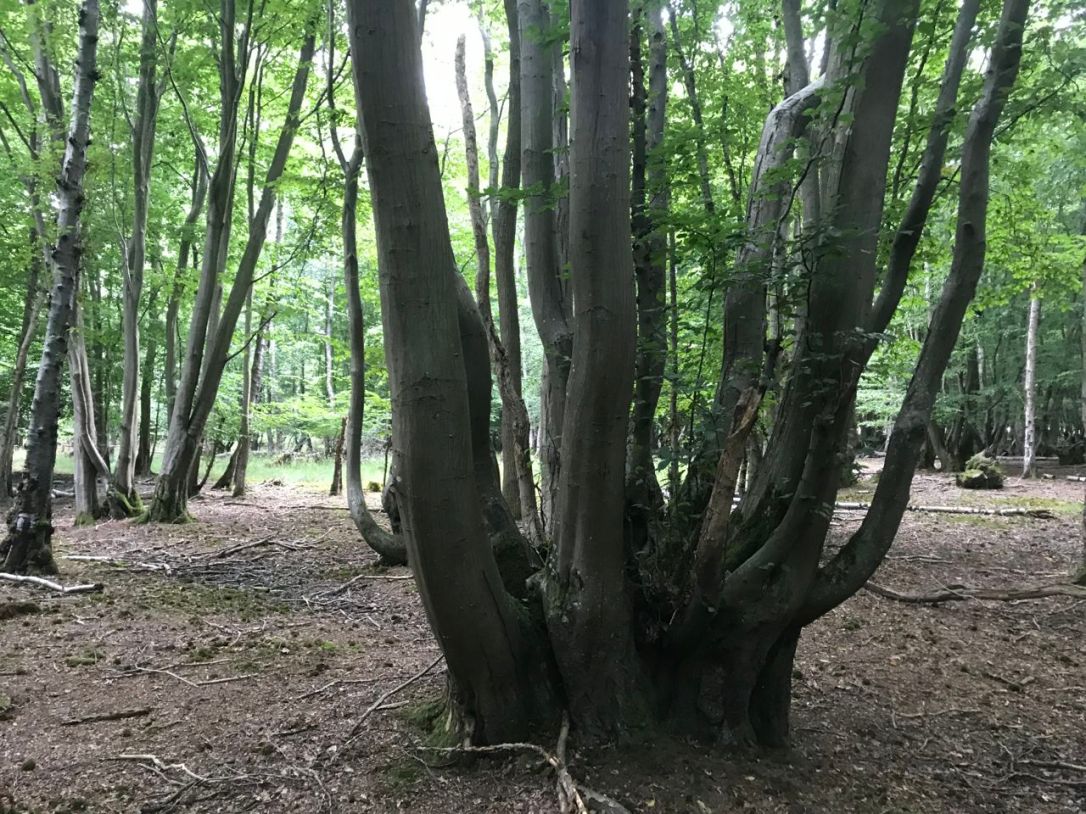
It did not disappoint. Amid 70 plus acres there are a good few of Hornbeam coppice, and it makes me wonder if Hornbeam Coppice was only popular in East Anglia, as I’ve only heard of it here, or is it just my limited geography. As Nathan says, they like good damp soil and Suffolk clay suits well. When would they have been last coppiced? We tried to guess, over 50 years we estimated. Their limbs now well over extended giving a thick canopy so the ground was empty of growth, except in sunlight patches, when dog mercury and a few ferns grew. Nathan says some parts full of blue bells in the season. The wood is untouched for years, and this does give it an ancient feel, and one of awe and respect.
Along the ditch some higher pollards giving of between 12 and 30 stems each. One hollow, yet still strong.
We got as far as the woodsmans cottage – a romantic dwelling in the heart of the woods, now inhabited by briar and ash. The stuff books are written of, dreams are entwined.
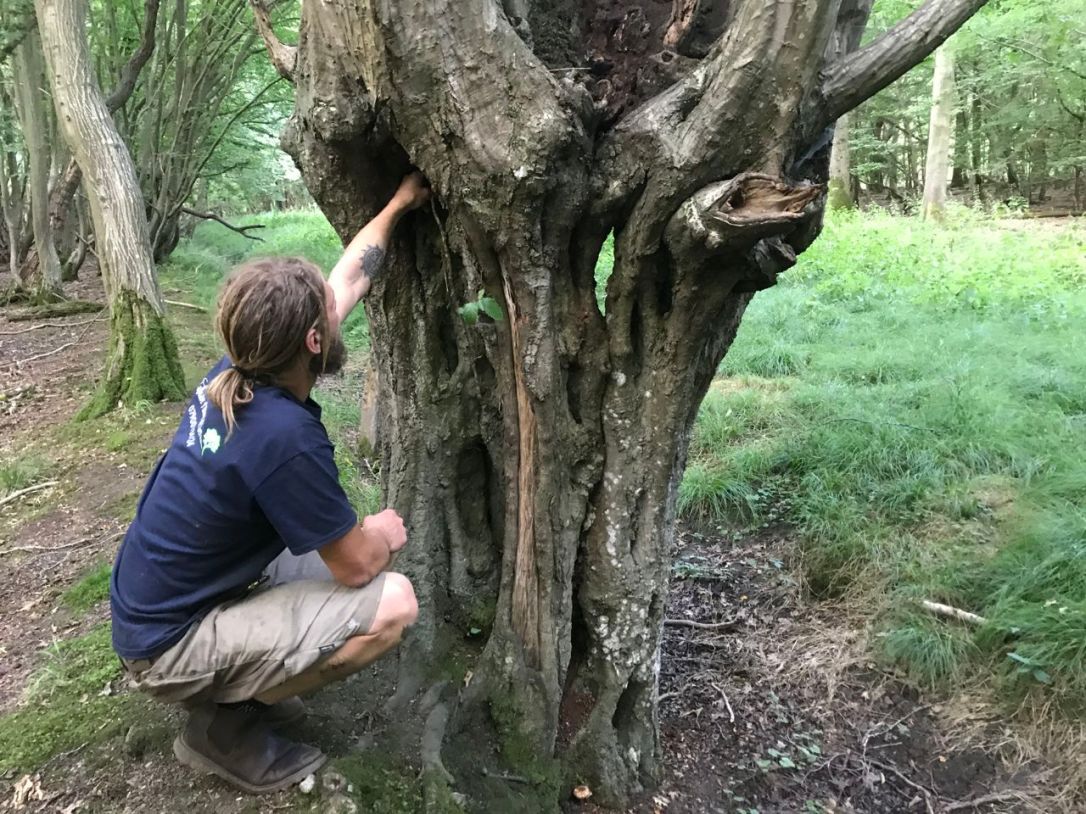
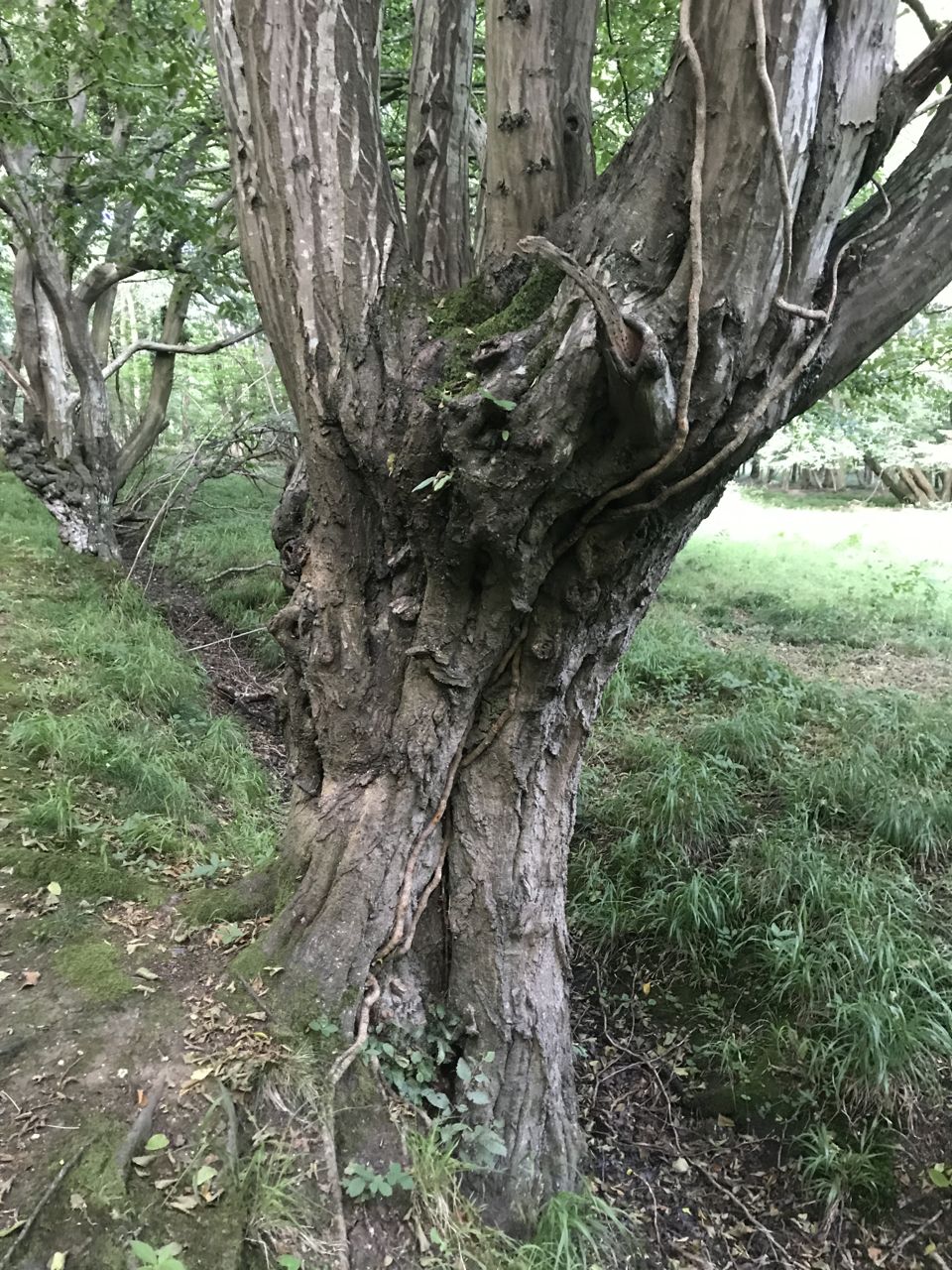
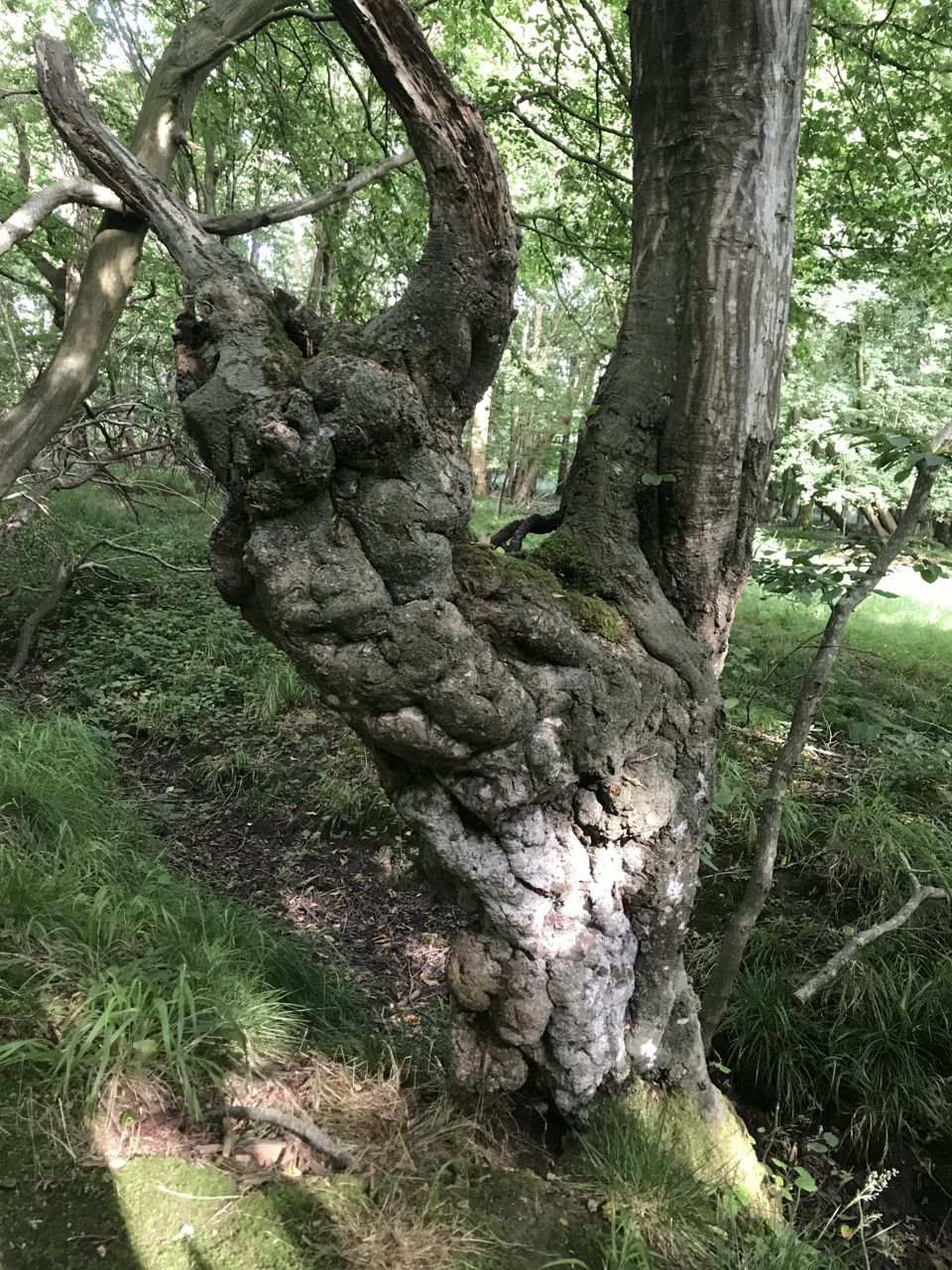
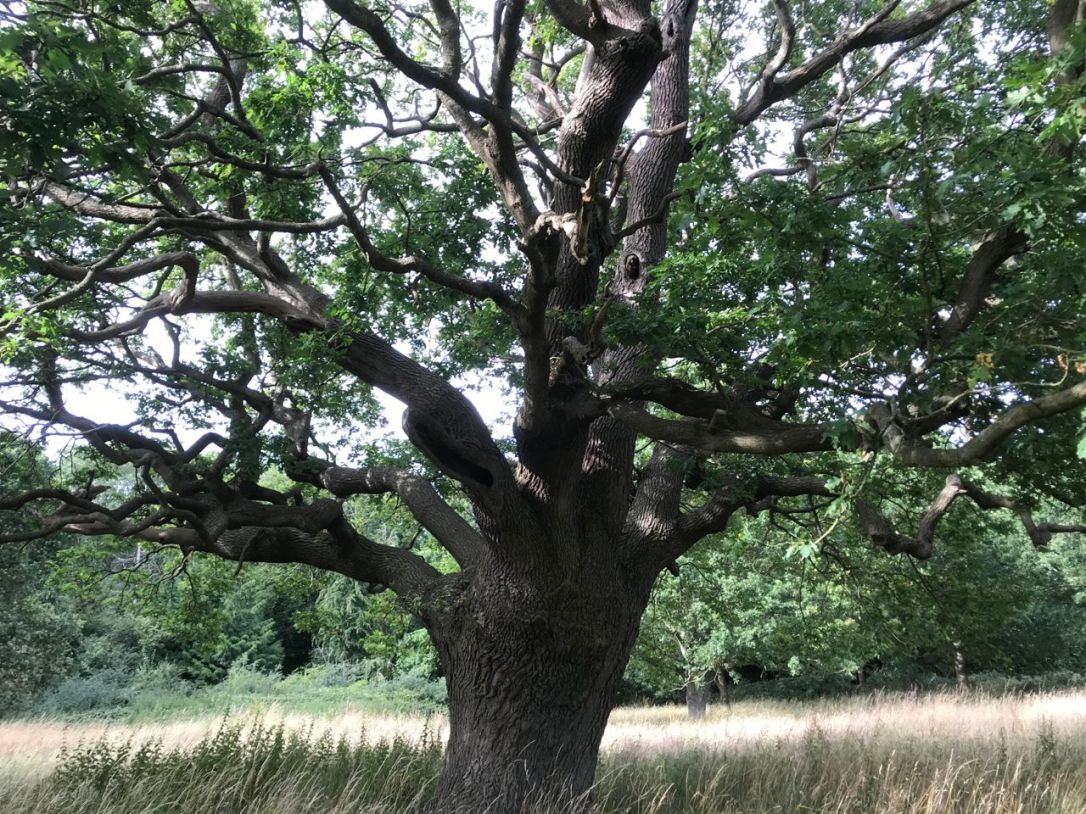
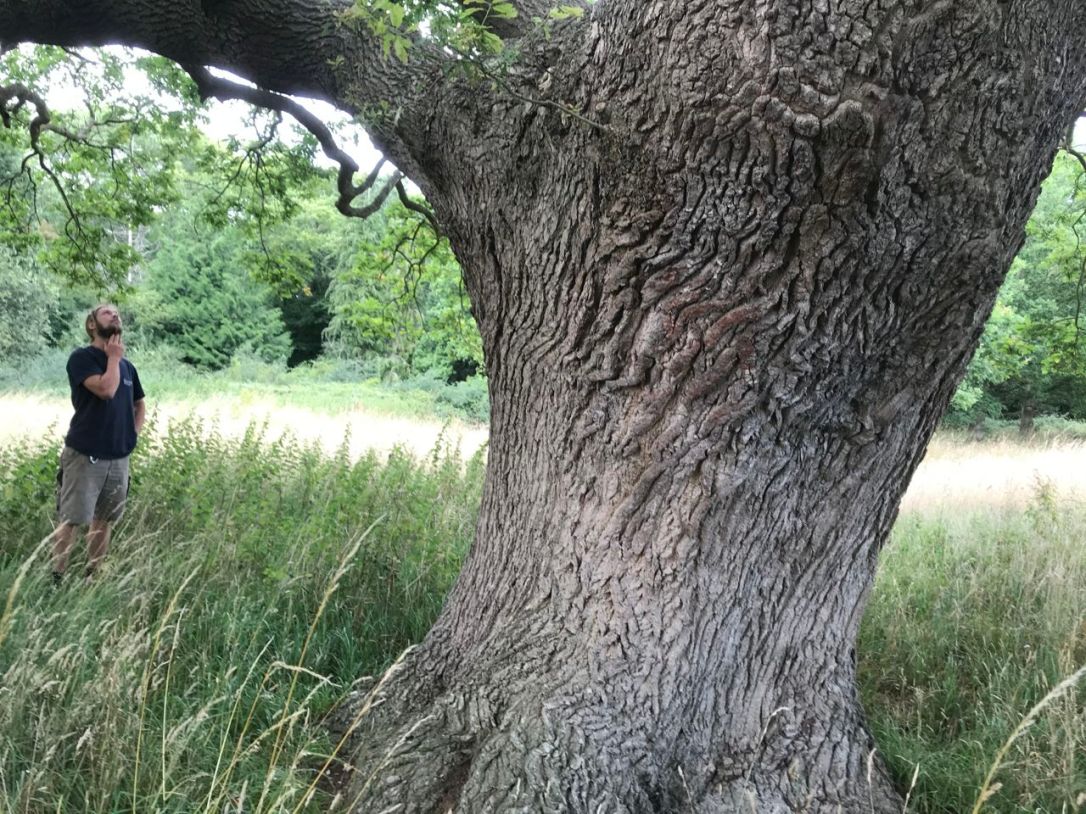
We came out at the wood edge to a group of parkland oaks, old pollards one of which reminded me of Staverton Thicks oaks, may be the same age – 3-500 years old.This one below a trunk supporting 3 massive stems large enough as Nathan said to be trees in their own right.
I’d just read in Oliver Rackham of the first findings of coppicing.
Rods, poles, and most timber did not come from wildwood. Occasional giant trees were used for making dog-out boats or woodhenges, but for ordinary purposes such trees would have been impracticable to cut up or transport. As in the modern Amazon, most of the trees that come from destroying wildwood were wasted. . … Early Neolithic people had already made the discovery which is key to woodland management: that the regrowth shoots from a stump are more useful than the original tree… The twentieth century conditioned to think in terms of timber, finds it difficult to grasp the immense importance of underwood in almost everyone’s life in prehistory.
Describing this to Nathan, he responded that he had Oliver Rackham’s notes on this very wood and would look them out for me.
Background information: John Hill bought the small Blyford Hall Estate of about 670 acres in 1944. This comprised the four farms of Blyford Hall Farm, Ivy Farm, Walnut Tree Farm, and Suttons Farm, and also Blyford Wood. Soon afterwards Hill bought the Watermill Farm at Wenhaston and its neighbouring land which comprised 300 acres and a further three mixed farms. Substantial further puchases of Henham land were made in the 1950s. The properties were mainly leased out to tenant farmers. The Blyford Estate is today still farmed by members of the Hill family.


The woodans cottage was in fact the gamekeepers cottage . My dads family lived there in the late 1930s- mid 1940s. My grandad, Henry Gower, was the gamekeeper. They used the pond for drinking, cooking and washing water. After they left services were put on, but ,apart from being used for a while as a holday cottage ,it was never inhabited again. We used to visit up until 1980. Would love to see the cottage again.
LikeLiked by 1 person
Thank you for adding this piece of the mosaic. I did go up there again the other day to walk amongst the hornbeam.
LikeLike
Hello Sue, that’s fascinating to learn. I would love to know if you have any photos or other records from your grandfather and his time as gamekeeper in Blyford? I’ve seen a few photographs and other bits and pieces, plus I remember listening to a recording of his son (possibly your father) talking about living there during the war.
Best wishes
Jamie
LikeLike
I’ve got several photos of my family at the cottage. Have also got photos from their time at Scotts Hall estate, Minsmere, before they moved to Blyford. I would think that recording was dad’s younger brother ,Russell, who passed away a few years ago. Both Russell and my dad , Ron, were given trips round the wood by the gamekeeper, Mr Buck, in the 1980s. I would love to listen to that recording!
LikeLiked by 2 people
Hello again, Sue. I have to say I would dearly like to see any photos or anything else related to your grandfather and your family’s time in Blyford – if that would be possible in any way?
But yes, you’re right – the recording I mention was of Russell Gordon Gower. It was a few years ago now, but I remember sitting in Norfolk Record Office and listening to it on cassette tape. But having just re-found it on their online catalogue of records, I see that (most wonderfully) it has since been digitised – meaning we can now listen to it online! 🙂 So find the link to it here below. It doesn’t seem to say when it was recorded. But the description of it says the following:
‘[Russell] Gower outlines his background living at Blyford Woods, near Halesworth airbase, and working on the airbase with the Air Ministry Works Department in the electrical workshops, 1942-1946. Outlines his duties, working primarily with lighting repairs. Talks about witnessing the arrival and departure of the 56th Fighter Group, 489th Bomb Group, Air/Sea Rescue and the Fleet Air Arm from Halesworth airfield. Refers to the bracelets made from threepenny pieces by the electrician which were popular with the American servicemen.’
https://digitalarchive.2ndair.org.uk/digitalarchive/ImageBrowser?catNum=mc_376-502a#NRO_MC376-502a_i1_s1_f1_v1#NRO_MC376-502a_i1_s1_f1_v1
LikeLike
I’d be interested to know how you found me here!
LikeLike
I google the wood every so often to see if any new info has been added.
LikeLiked by 2 people
Hello Sue. I can tell you that since the purchase of the Blyford Estate by Jon Hunt (he of Heveningham Hall, etc.), a plannnng application has gone in to ‘restore’ the keeper’s cottage as a (upmarket) holiday let! I have very mixed feelings about this really. But I suppose it’s better that way than for it to fall into a state of complete dereliction, as I’m sure would have been the case otherwise.
Anyway, this application has yet to be decided upon. But if you follow this link (below) and search for the ref. number DC/22/1443/FUL then you should be able to see the associated planning documents – some including photos of the cottage(s) as it is today.
https://publicaccess.eastsuffolk.gov.uk/online-applications/search.do
LikeLike
Did you ever get hold of Oliver Rackham’s survey, notes, etc. of the wood?
LikeLike
No I didn’t and Nathan left. Good reminder. It’s now owned by Hunt.
LikeLike
I just stumbled across this by accident today. My father was the keeper on the blyford estate from the mid 60s to 2010s, as referred to in an earlier post, Mr John Buck. He could probably tell you how close your estimated were for the copicing of the hornbeam as it was likely him who did it or had a part in it in that time frame.
I was lucky enough to have Blyford wood as my own childhood play area.
LikeLike
How interesting. I would very pleased to talk with your father about the coppicing.
LikeLike