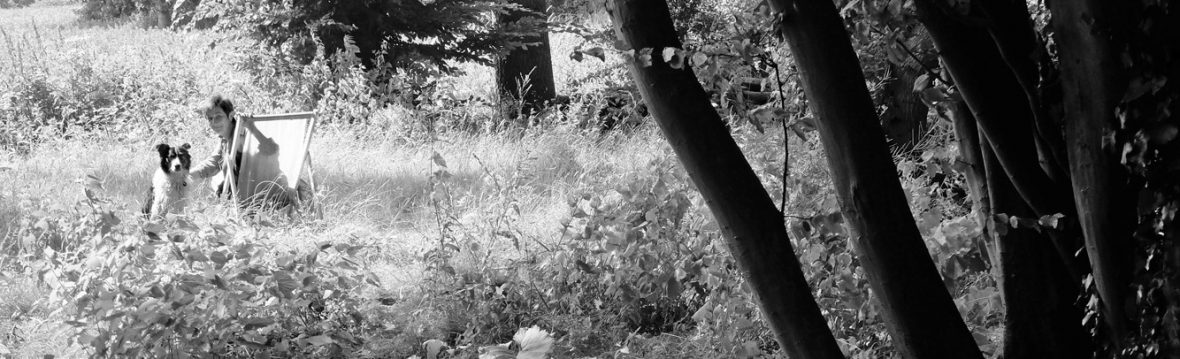
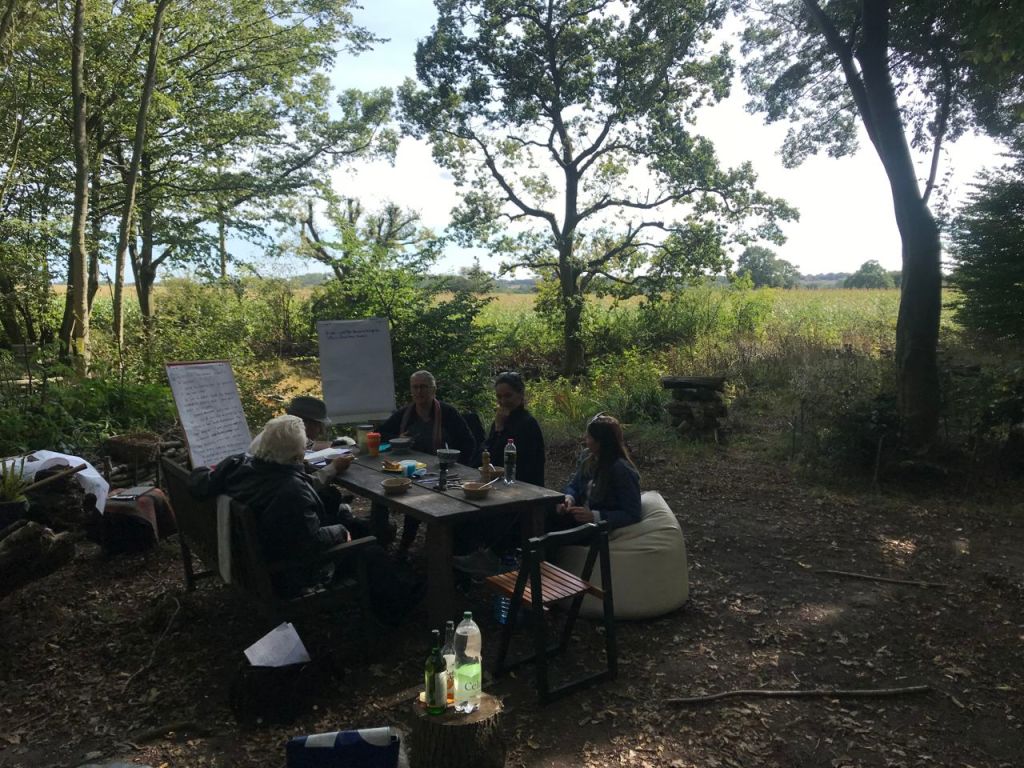
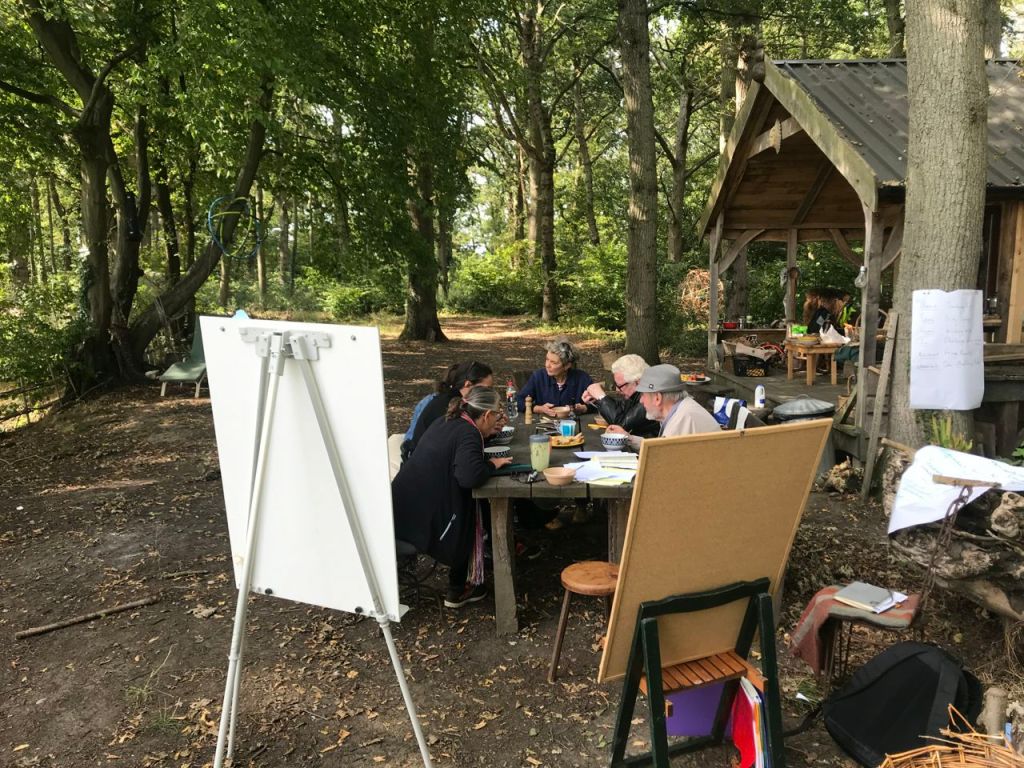
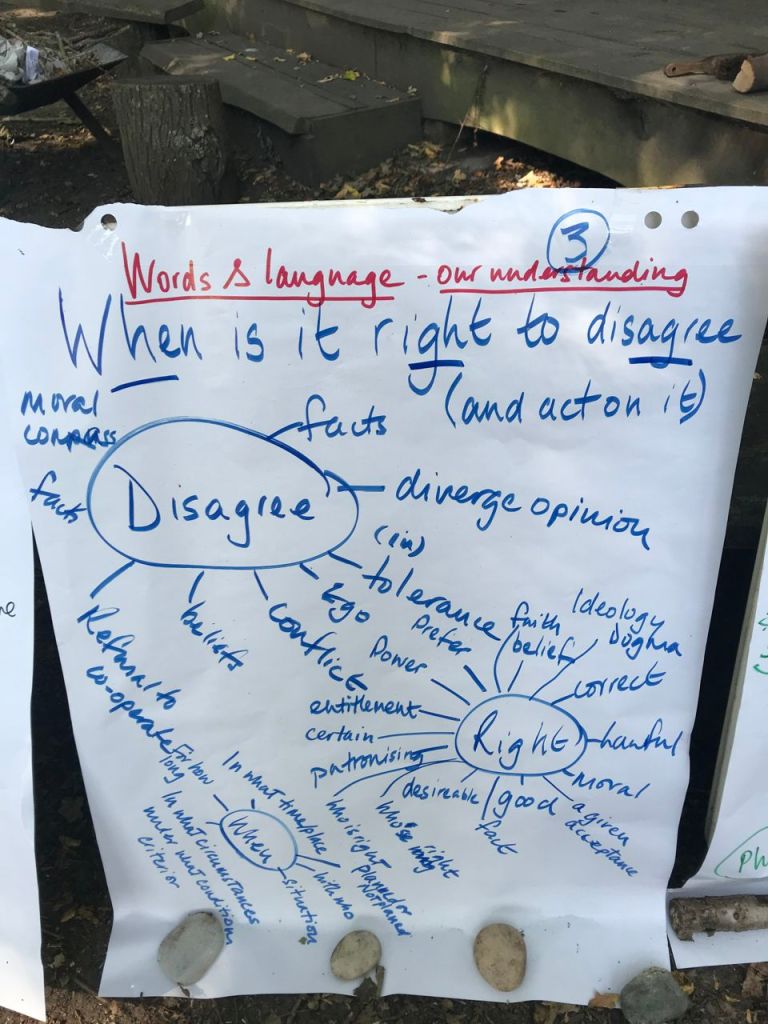
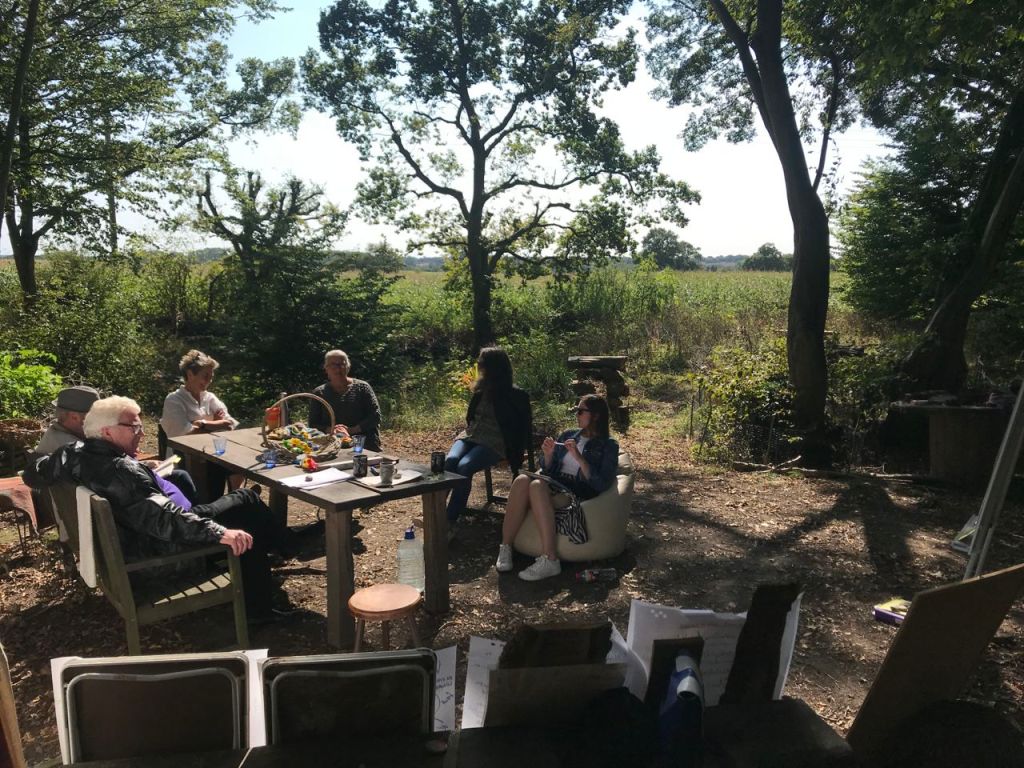
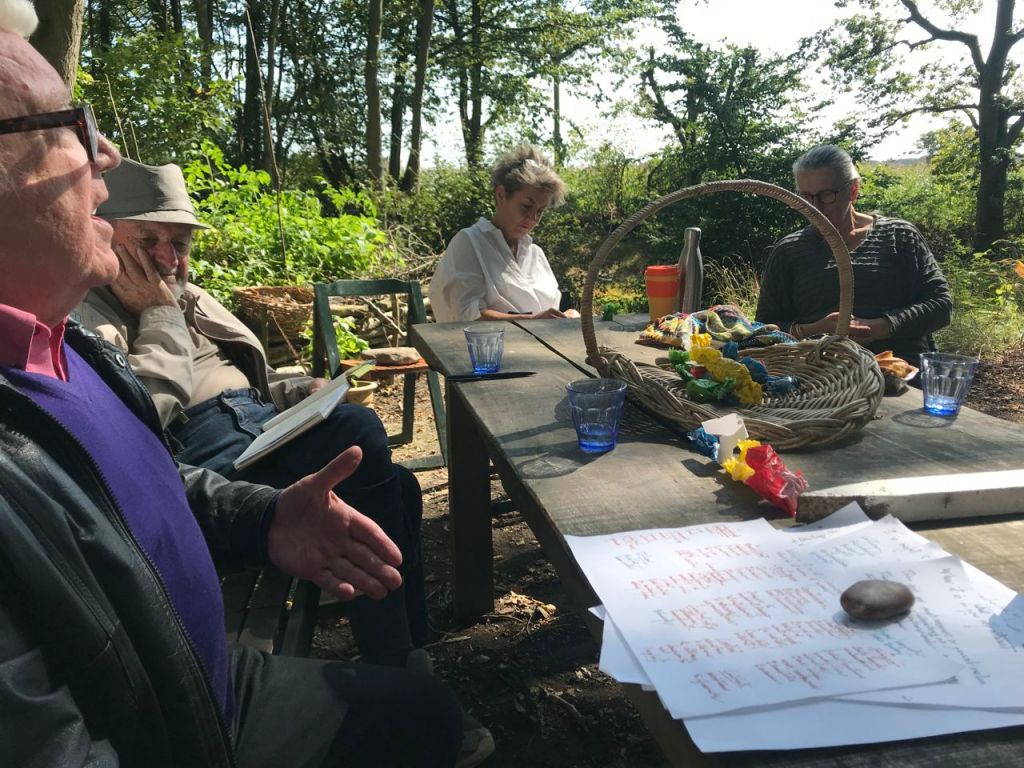
Blessed with glorious September warm weather, lowering sun filtering kindly through oaks, we gathered in Kaliwoods to talk around the question: When is it right to disagree (and act on it).
I’d worked on the same question in a 5 day Socratic dialogue in Springe, with Unathi as facilitator all 5 days of it, over a year ago now. I thought then, what a good question it was to explore. Here it manifests in a day and a half with me facilitating. Although my 3rd facilitation since learning under the guidance of Dieter and Julie Marie, it is and feels like my first independent facilitation.
Organising in the woods (COVID-19 Risk Assessment) necessitated a cleaning out of the cabin, (finding an olive oil bottle top chewed and 2 death by Olive Oil mice sunk to the bottom), chairs, pin board, blue tack – and food of course (mushroom soup, cake, cheese). Finally, the way now clear, the evening before I began the preparation of the subject, not by reading Kant or Socrates, or Leonard Nelson, but re-reading my first Socratic Note book, from Cambridge, to Springe, of Dieter, table tennis and Michael’s support, recalling along with lessons learned, what I found stimulated the thinking. Yes, returning to the richness of direct experience.
We gathered. Anna my fellow socratic practicioner who had recently so inspired us and opened up the geography on Zoom, arrived by train on Friday evening. She was a blessing. At 28, she is far older in wisdom. Les had galvernised, reminded and so enthused, he had proselytized inspiring both Emma and Annabelle to come. Michael, with whom I had first experienced my Socratic dialogue with Tamsyn at Magnolia, facilitated by Julie Marie, the spring board to where I am now.
Sara, my friend and fellow thinker, was the first to arrive on her new electric bicycle, rolling down the winding wood chip track in her high viz neon yellow jacket.
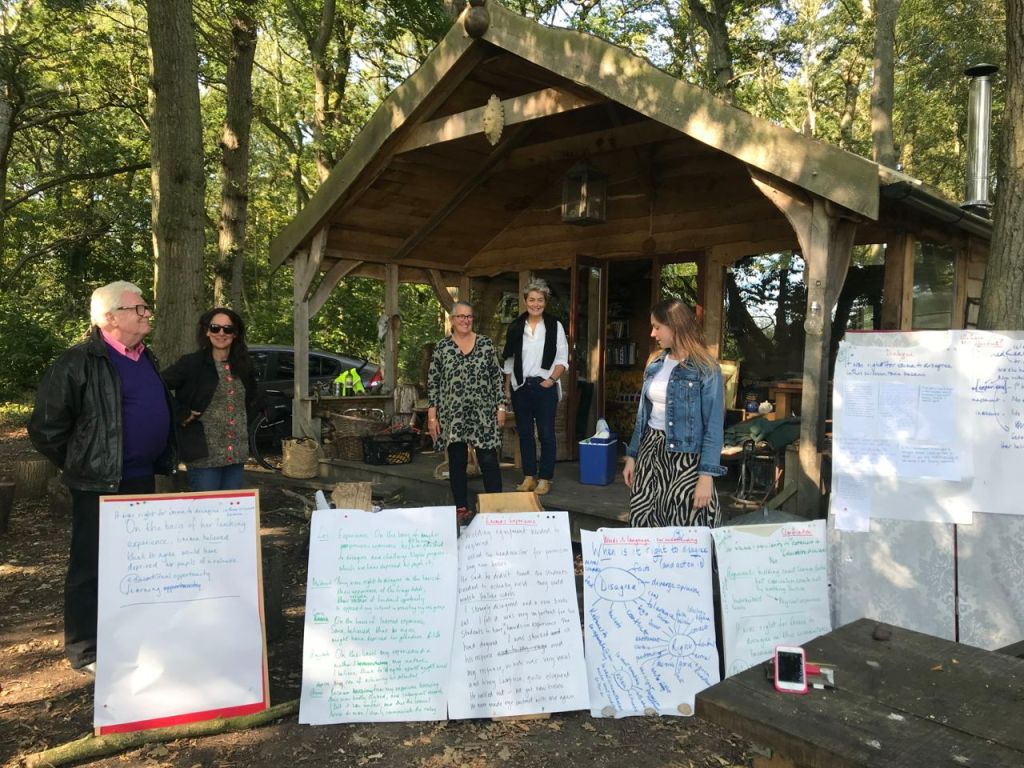
We were 6 to explore and swiftly decide to work in the COVID-19 safe outside: where to pin up the A1 sheets of paper. Oak trees of course.
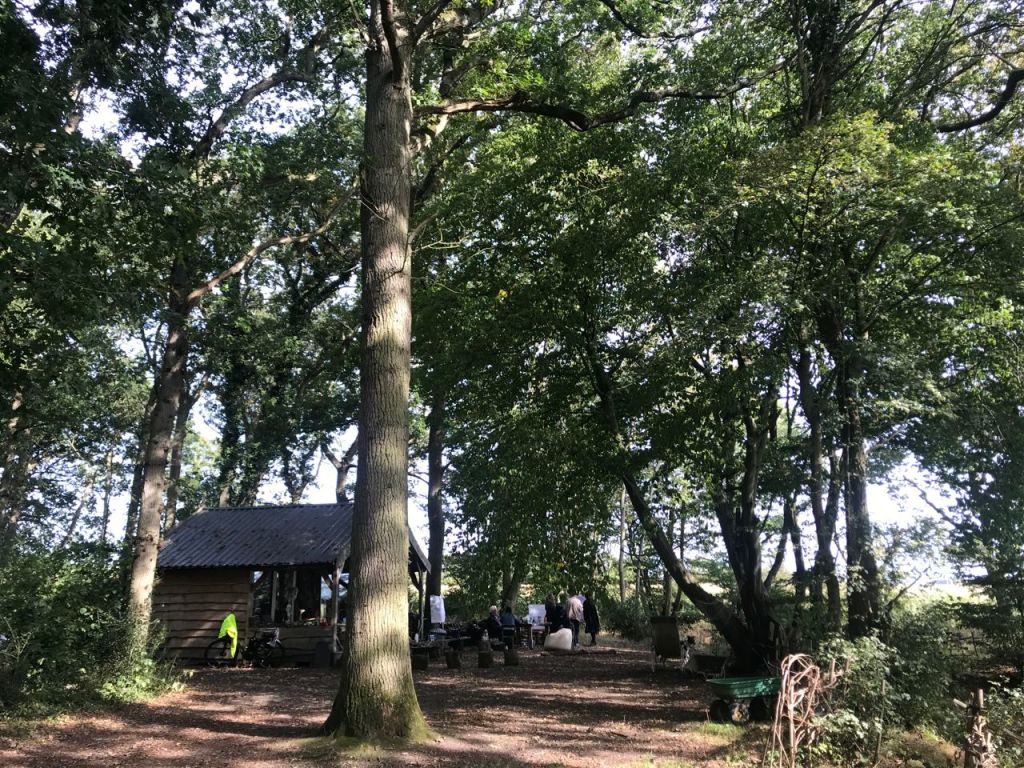
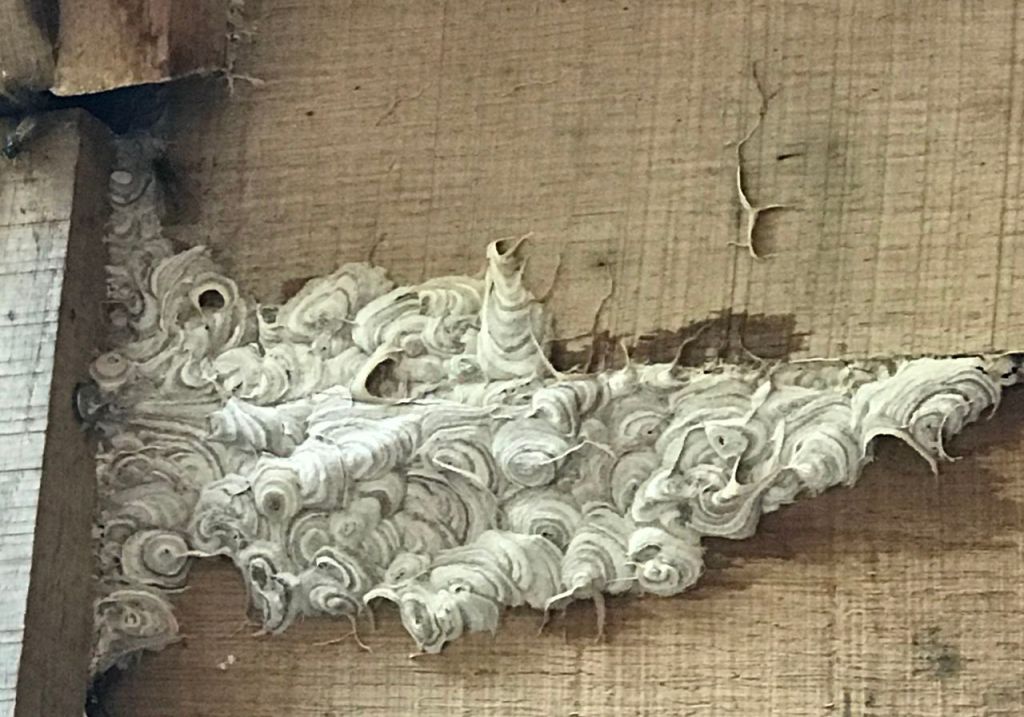
We gathered. First in a circle, under the great hornbeams, their coppiced limbs twisting and turning up to the sky, so we stretched our arms, hips and bodies and finally our necks looking up. We were in the woods. H&S check, tippy taps, compost loo, wasp nest aware.
I always love the introduction. I’m good at this, taking a long run up (sometimes to the detriment of the matter in hand), recalling the beginnings, so sweet to remember. Socrates to Leonard Nelson who formulated the present form in a time and place (Germany before WW2) to counter dogmatism, not teaching philosophy but philosophising, finding our own views. From Nelson to Heckman to Dieter Krohan, who taught me, via Tamsyn and Michael the circle completes.
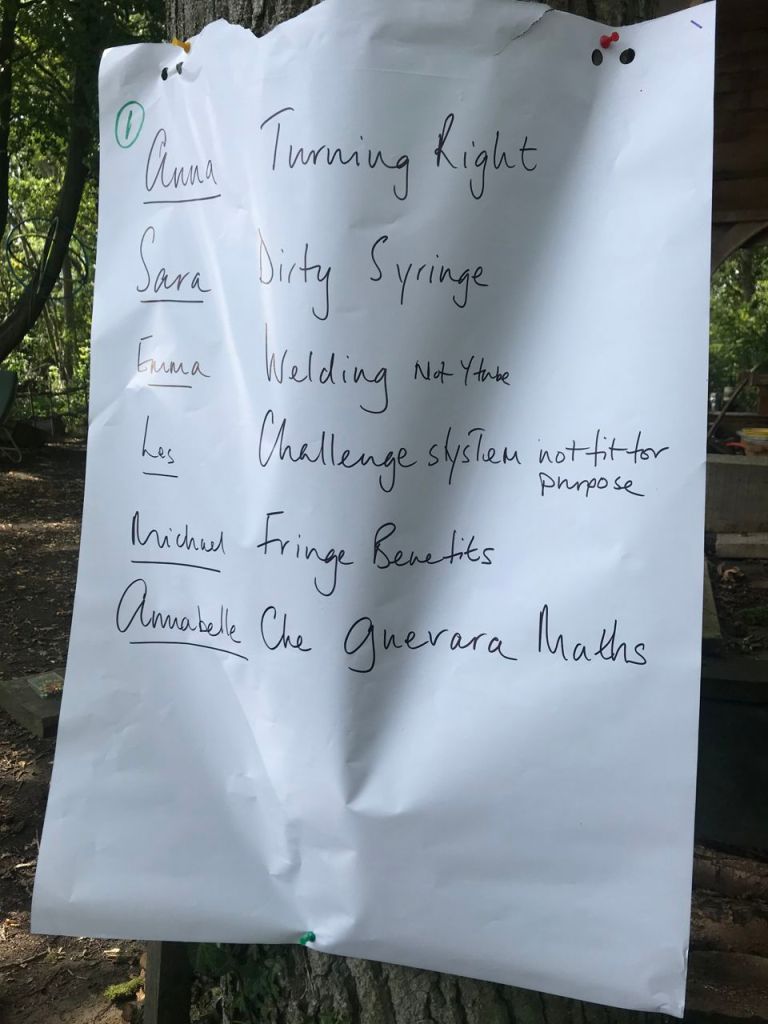
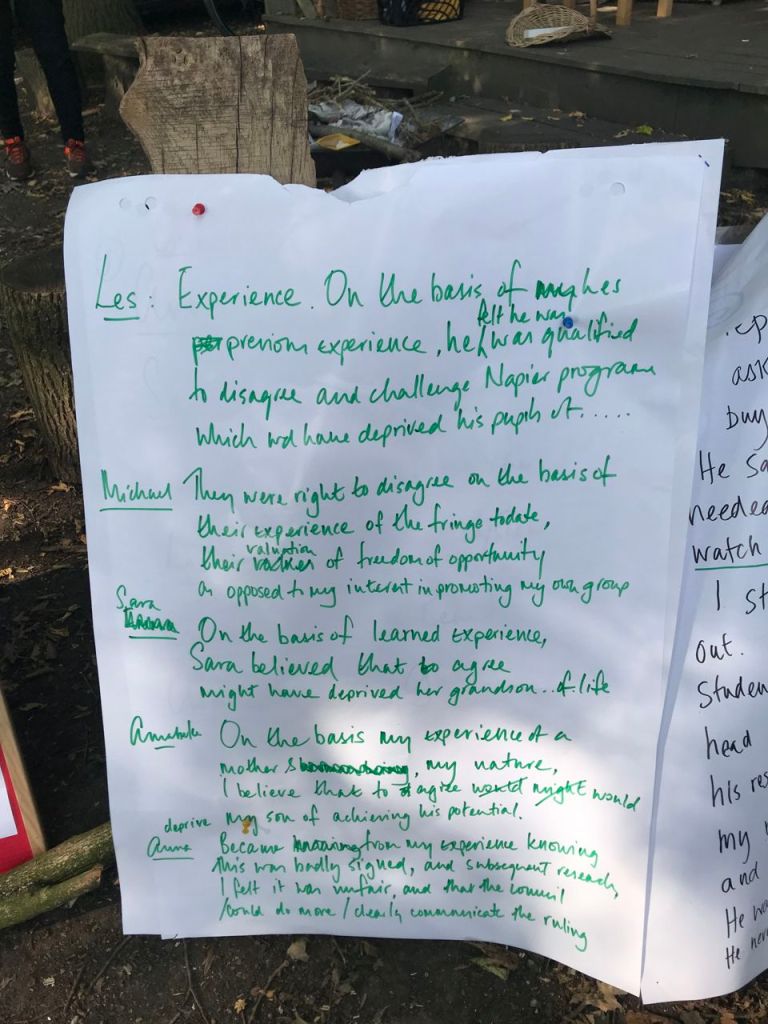
We introduced ourselves, with the addition of an animal – and I forgot to ask why this animal, because the why is the most illuminating. Michael the dog, Emma the otter, Les the snow leopard, Annabelle and Sara the dolphin, and Anna the fox. We gave our examples: Anna – Turning right, Sara – the syringe, Emma – Youtube V welding, Les – No 4 challenging the course structure, Michael – Fringe Benefits, and Annabelle – Che Guevara Maths.
We chose Emma’s and by the end of the day were all convinced on the merits of welding. She’d never done a Socratic Dialogue before and being the example giver did weigh on her, as she kept attempting to bat the the story away from herself, but she was a brilliant choice, both in the simplicity of the example and in her clarity of explanation.
The clarification merged into the dialogue. My first error was not distinguishing between these two moments. Anna, trying to signal me, asked about the core statement, and rather than just Emma giving one, I invited all to write down what they thought was the core. Before we had explored or examined the moments in the story. But the writing down was focusing, and gave a kind of breathing space between the views that came rich and fast, too fast for me. My 2nd error was breaking into pairs to find the denominator in all of these statements. The 3rd was to take the negative first. However, the negative resulted in a lucrative discussion on the role of experience, a word which eventually ended up in the final core statement.
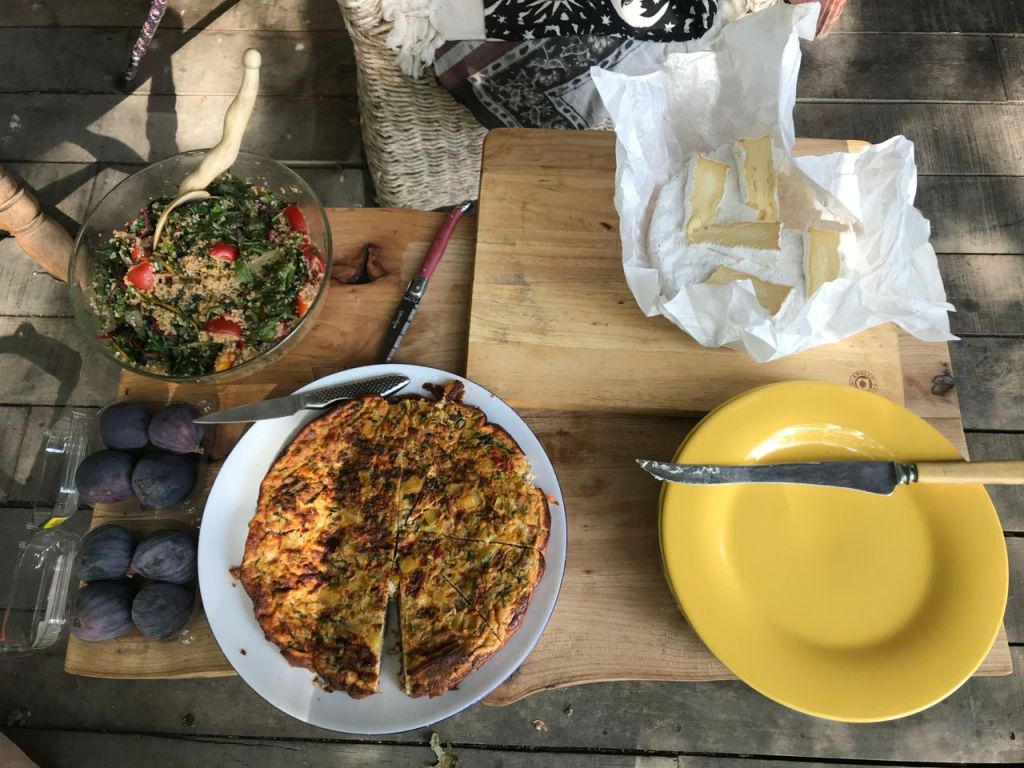
The lunch by the way was delicious. Les’s Parsi omelet with Annabelle’s salad washed down with Emma’s beer.
It was the end of the day, after all had left the wood, that Anna put a mirror up to me, and I began to see. I should sit on my hands more, invite others to do the work. Above all, she observed, we were all keen to make statements rather than question. I had not noticed, but now saw what she said.
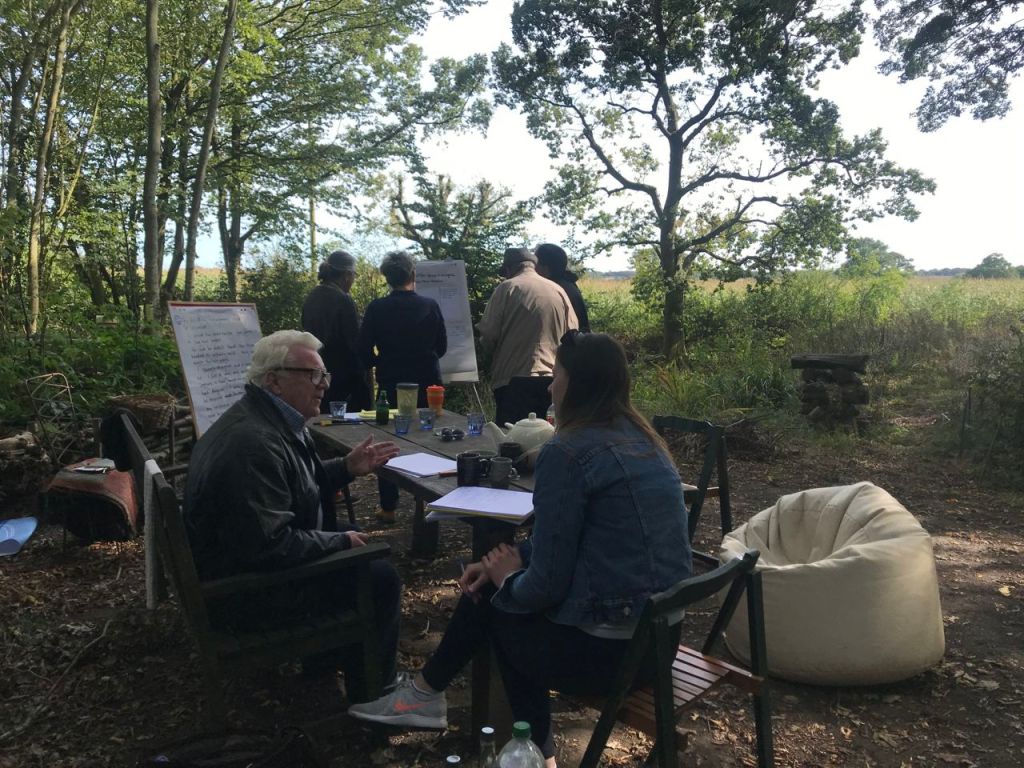
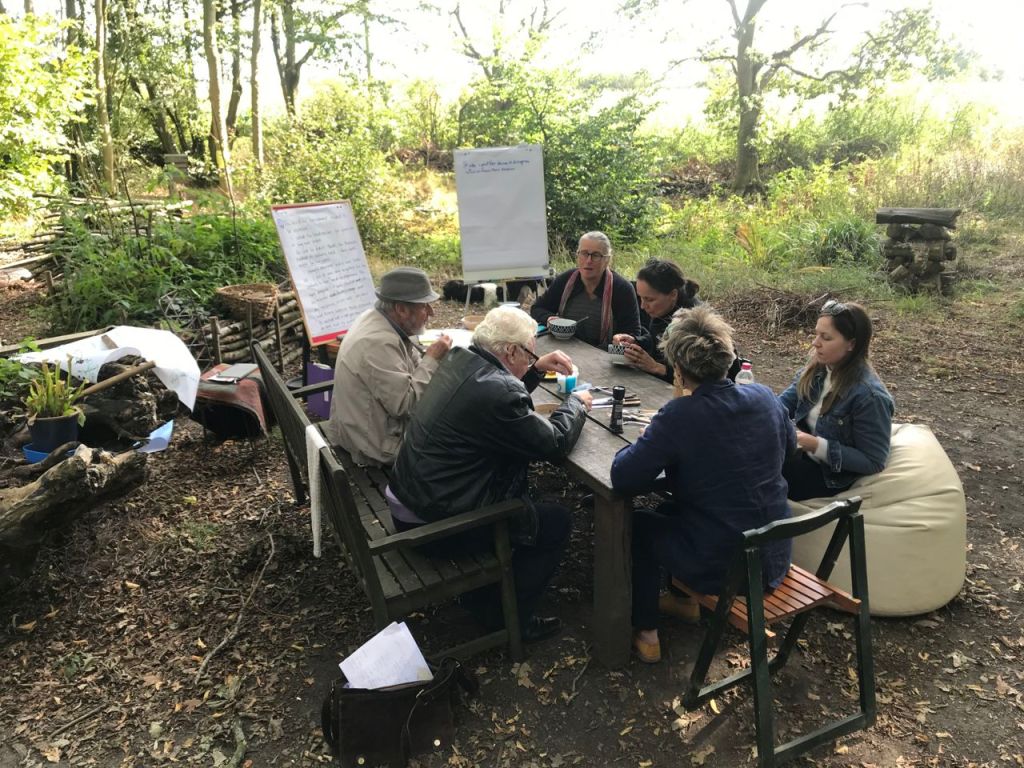
Sunday I arranged the space, numbered the A1 pages, found a red thread through them, pined them up on planks of wood. I was ready.
We gathered. ‘Yesterday Emma asked me why are you writing? I answered immediately, glibly, confidently, ‘So we don’t forget’. That was a blocking, unhelpful, uncooperative answer. It was an important question… ‘ So I extrapolated the reasons, along with my errors of the form yesterday and ending with our need to ask more questions and catch our habit, like mine above, of making statements.
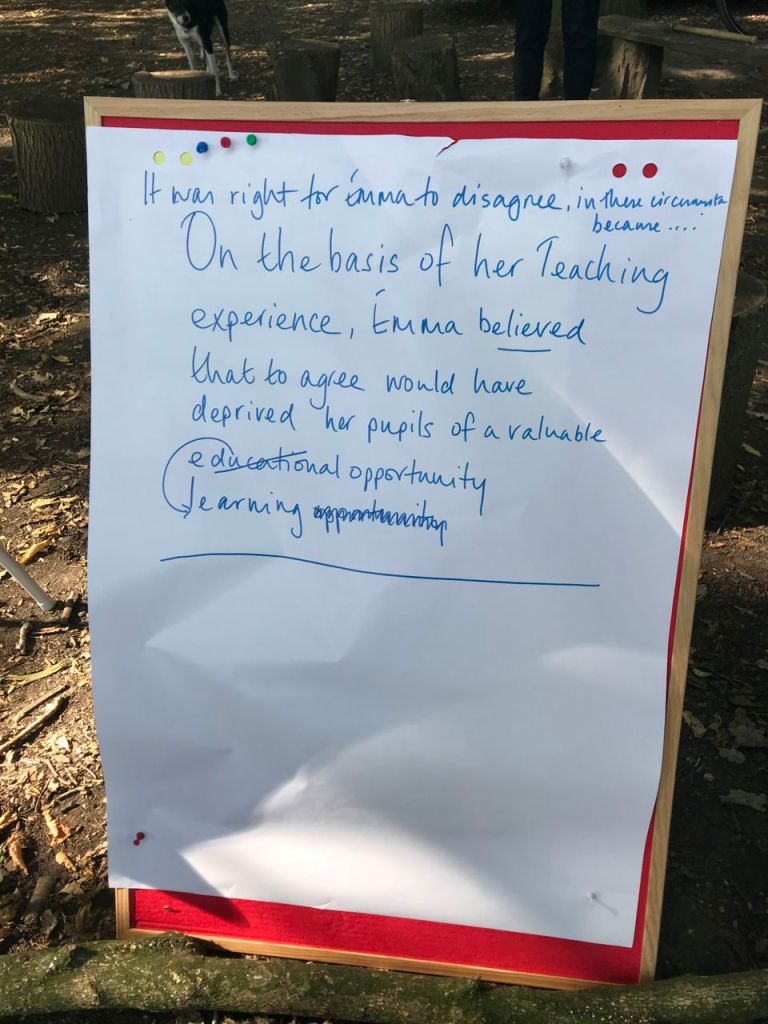
We cracked on. Finding common words in their statements, Sara found a simpler core, to which we modified and tweaked and here it is:
It was right for Emma to disagree in this circumstance,
on the basis of her teaching experience, Emma believed that to agree wold have deprived her pupils of a valuable learning opportunity.’
They wanted to know the core statement from the 5 day dialogue in Springe. Here it is
It is right to disagree (and act on it) when…When something of value is questioned and when the disagreer is confident that their judgement (based on reasonable expertise) can effectively challenge.’
Socratic Dialogue Springe 2019
We returned to the beginning, seeing if we could apply this core statement of Emma’s example with our own. Les, who’d been convinced that none of this would have relevance to his 7 examples of disagreement, was surprised to find that it did – well just for a moment anyhow. No doubt we may have straight jacketed a few arms in to sleeves, but the general body fitted, and this was a sweet circling. I’d wanted to do this at the end of dialogues in the past but it had never happened before – a successful addition I think. We began to find other avenues to explore, such as feeling of constraint being a motive of triggering disagreement.
Over Barron Bigod cheese, delicate snacks bought by Sara, a beer or two, we lunched, and some said they were disappointed that the day had ended, that they wanted the exploration to continue. Along with this, the meta dialogue at the end made clear a few important points: the form was not clear, the need to simplify the core statement. Good for brain work, said Les. Annabelle enjoyed the moments of going deeper into ideas and language. Emma, although relieved when the subject moved away from her to a broader spectrum, had enjoyed the process, wanted to do it again. It was a luxury to be in the woods and explore ideas. And not one moment had we entertained the thought of COVID-19.
Lessons:
– Handwriting – yet again, can i recondition? Remember
– Invite others to take part, sit on hands more.
– Clarification/Dialogue. Look at the example, find the elements within it that answer the question. When / Disagree / Right (right for who?)
– Pairing, although successful, needed to be in a workshop not a dialogue, and needed much more clarity.
– Evening in between – do nothing but be by myself. We went out to the Racehorse pub
– Work with Anna again. I learned more from her critic than I had done before
– Do it again!


