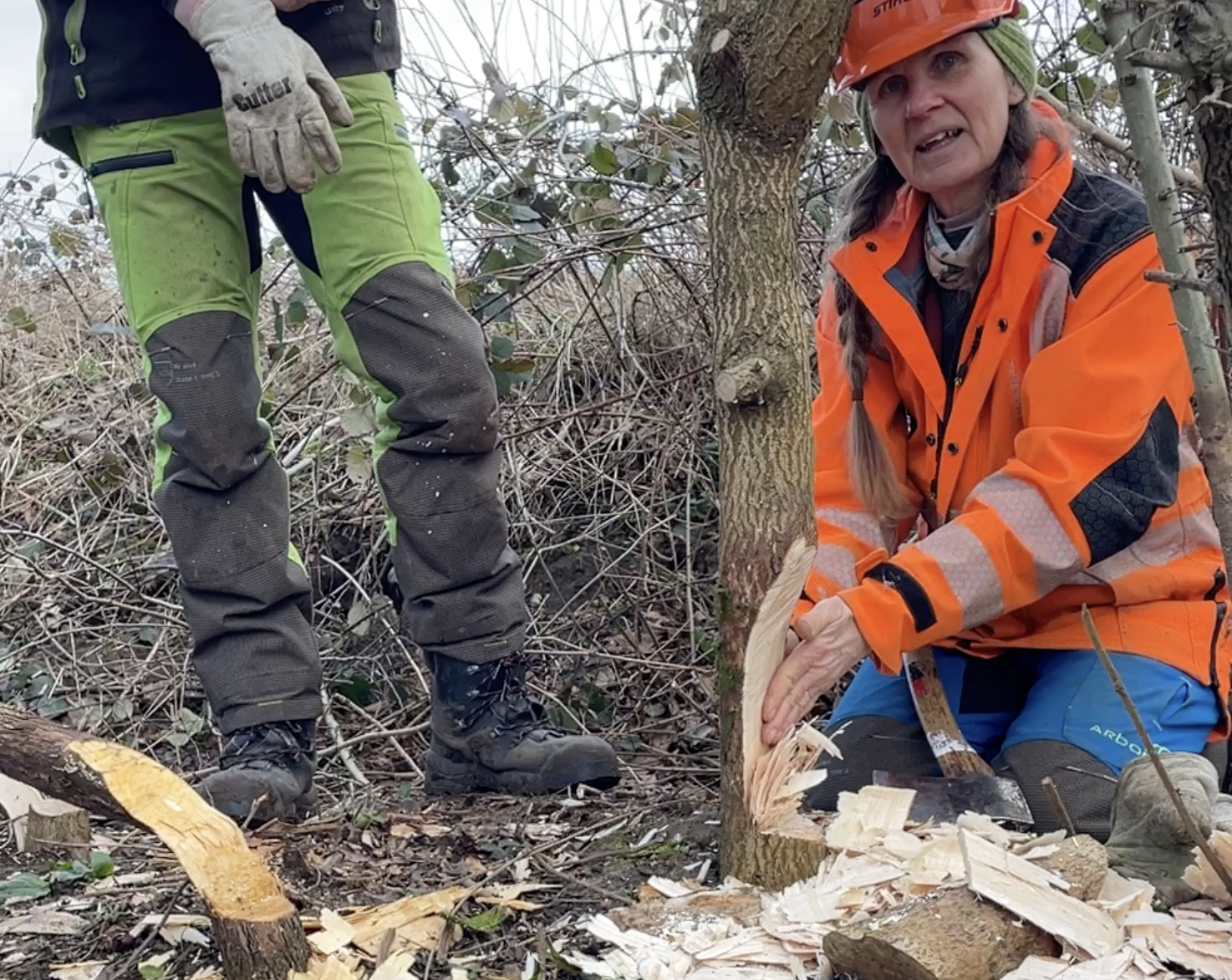
As I drove the 2 hours to Waldringfield on a cold east wind Sunday, I did doubt my motivation. But this was swiftly assuaged as Alison began her careful introduction and shattered my previous lay knowledge of laying. Clearly I had never encountered the Midland Bullock method, and had merrily developed my own random style. Her care and attention to small detail as well as her respect for the natural systems was admirable. But what I will take away was her care for both the plant and the tools. In the photograph above she strokes the cut maple, to check on temperature and smoothness.
We were a small group of 8 all tree wardens. Among us 3 girls, who formed the girl team: Clare, and the two Rachels – Rachel Smith-Lyte and I.
We started with HEATHERING – with already prepared hazel binders, adding and weaving to the top of the stakes above the already laid hedge. This strengthens the stakes as well as looks great. Some strength is necessary, as the hazels are wound around each other and then woven around the stakes. Notice the passive voice: I was aided by Roy who politely asked me to let him know if I needed assistance.
We were working on a hedge planted in 2008, part of Old School Wood a successful community run woodland (formed 2001 with the help of Green Light Trust, raised funds and purchased 5 acres of land near the church). Our hedge is a mix of hawthorn and maple with some wild briar and spindle. Our stakes were hazel already cut into lengths from another part of the wood, and we sharpened them (axe or billhock) in an area demarked with an impressive dead hedge. Nice to feel the community management of this woodland.
The hedge stems were a mix of big and small – ok 8 to 2 cm wide. To begin the Pleaching process, Alison drew a cut mark with her chalk, shaped like a half perpendicular church window, with a cut sloping inward at the base. ‘Maple does not lay well at under 2-3 degrees’ she advised, and indeed it did take some gentle nurturing in the form of shaving with an ax. The process of cutting away with the ax took a long time, and was sensitive to the wood not splitting. Us girls took it in turns! Alison and Roy (her able assistant) took over at the critical moment to feel if the stem was ready to bend, or needed more shaving. Once down it was held with stakes hammered in between the two lines of hedge plants.
We girls didn’t get to do any staking, but rather to prepare the heathers, we snedded the hazel with our billhock, often forgetting to take off the glove of the and next to the handle.
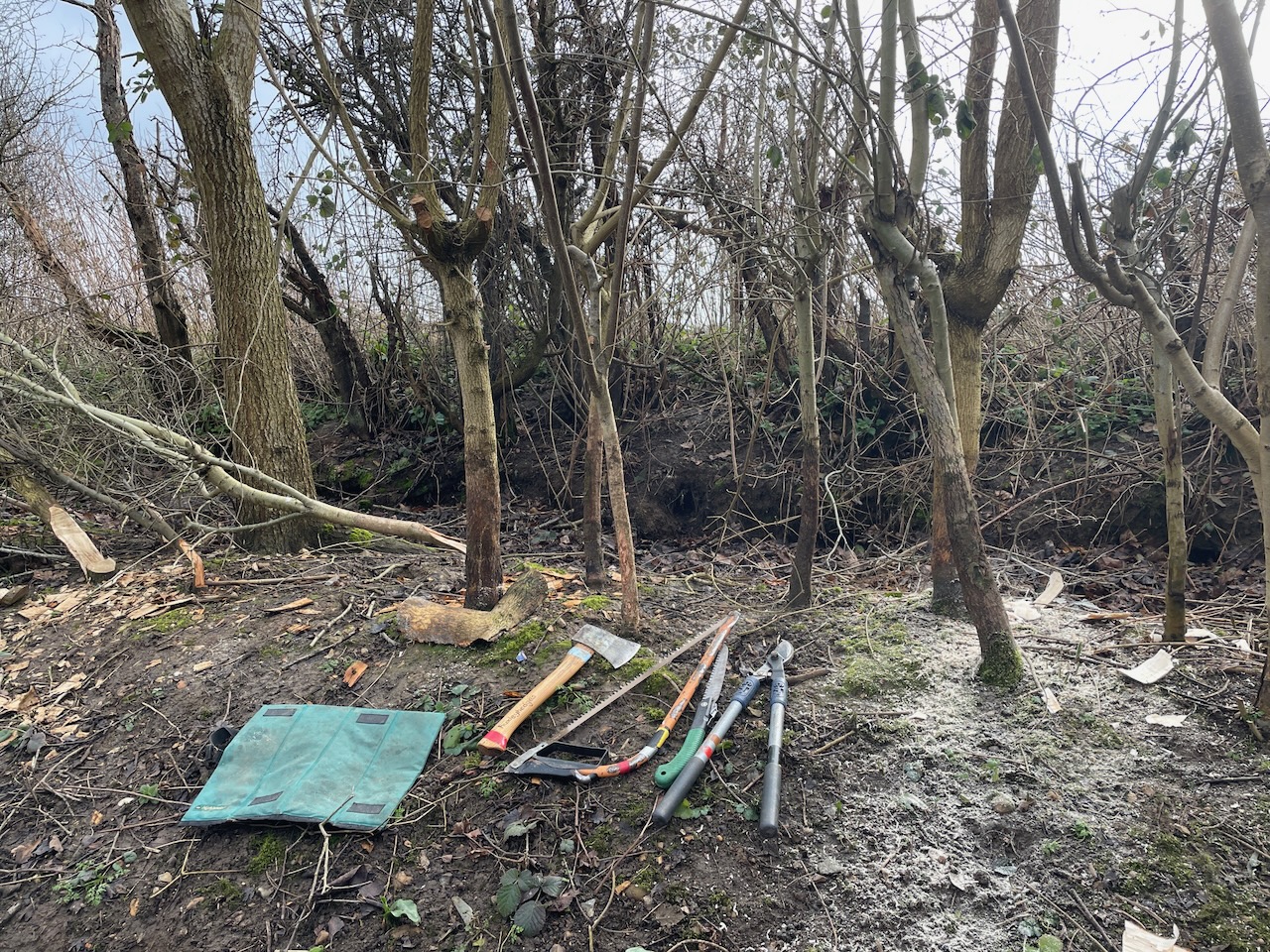
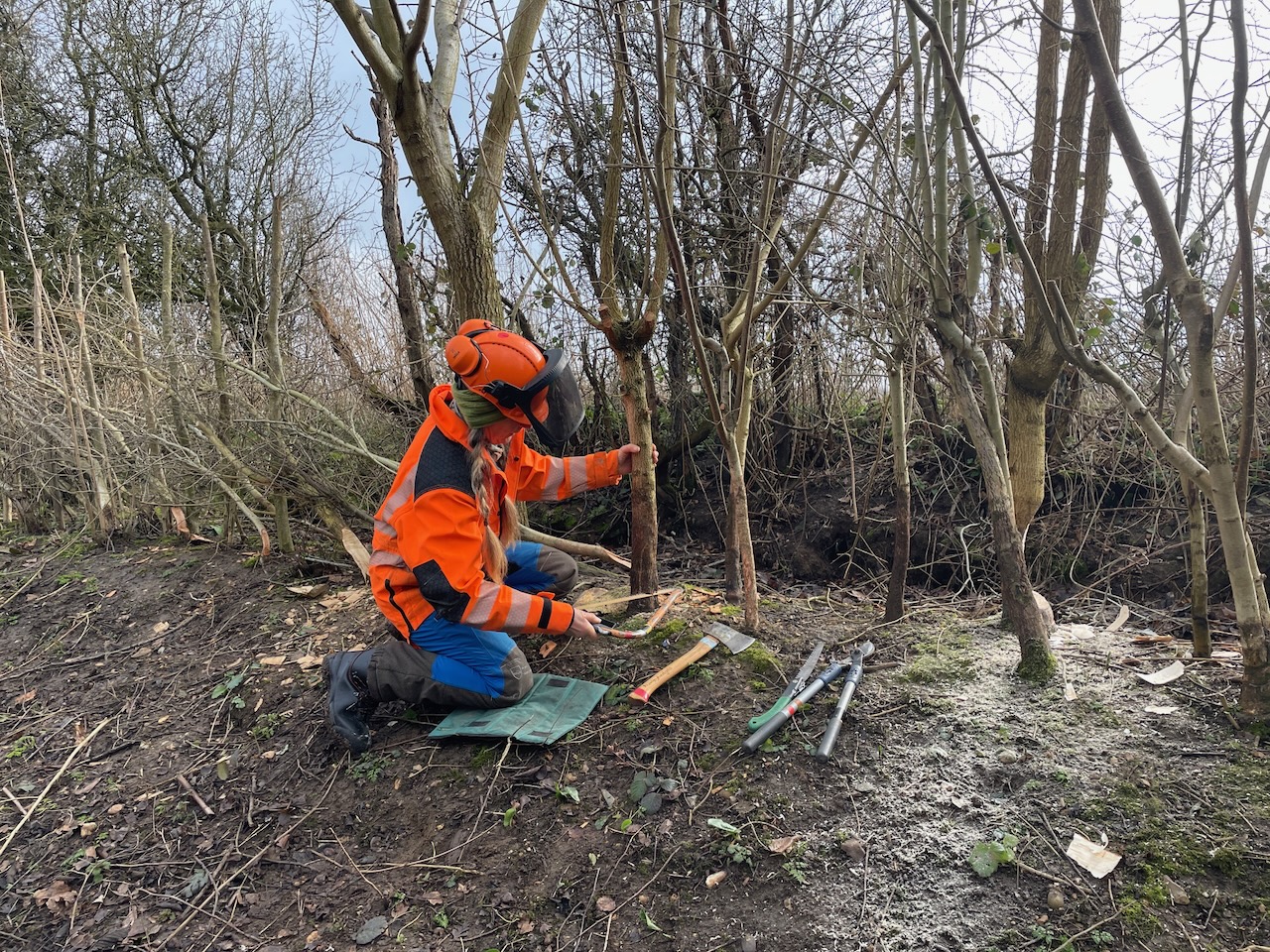


The next day, in warm sun, I went straight to the wood, and did a bit of hazel laying around the pond, taking care of my tools in the way Alison and modeled so effectively. I felt so grateful to have this wood to come to after the day of learning.


