
I found this question unexpectedly on a journey. Traveling up to the Lakes with Michael, we stopped at LangAr, the home of my friend Louise. We had become particularly close during a time of death and deep sorrow for both of us, and it had been a while since we’d seen each other, but we followed our lives on Facebook. It was clear, recently, that she supported a right wing freedom movement that challenged the role of the Government during this pandemic, inferring it’s actions were to curtail our freedom, and the corona virus nothing more than flu. We met and danced, and rather than address the benign elephant in the room, she posed the question: ‘Can I have a friendship with someone with opposing views?’ (By the way, we did the right thing, avoiding this dilemma and instead easily finding our touching points, re affirming our love rather than exploring differences.)

Dieter responded to this rather long question with helpful insight, which I hope he does not mind, I copy in full below, as there are points I may wish to refer back to one day.
Dear Rachel,
You have indeed chosen a very complex topic. The three central terms “friendship”, “opposite” and “view” do not have a clearly defined content, but each lie on a continuum of different shades of meaning. They range from “a little” to “100% opposite”. The degrees you speak about are determined by the chosen example.
Do you rather want to choose the question you also mention in your text: “Is it possible to have a meaningful relationship/friendship with one that has – sometimes unexpectedly – opposing views that will dramatically effect our futures?” This question is much more radical than your initial question. However, it should be noted that it is not opinion that directly influences the future, but action.
Some more thoughts on your topic. Would you like to clarify what the participants understand by real friendship and what such a friendship has to endure in order for me to call it real? I distinguish two cases, one is the emotional impossibility of continuing to feel friendship; the other is the rational decision to end a friendship because I know that continuing it would be a violation of my identity by betraying my own values. While the first case is about a psychological analysis of my inner experience, the second case is about a philosophical reflection on ethical questions.
Dear Rachel, I can do no more than give you ideas for a deeper reflection on the question and its implications. There is certainly much more to be said. But you need to choose the approach that suits you. I would like to be there. I am sure you will have a very interesting and intensive Socratic Dialogue. Please let me know how it went. Dieter
After a hint from Julie Marie, I changed the title to What are the limits of Friendship. It was not unlike the title of the very first dialogue I did in Magnolia House all those years ago.
With the latest government guidelines restricting us to the Joy of Six, this was our limit, and so it was on a dry October day we six met in the wood.
Anna had arrived from London the previous night driven by Joseph in his unusual Thai Rung Union motor car. I had met Jospeh on one of Anna’s zooms and indeed this would be Joseph’s first ever face to face dialogue. Always good, I think, to have at least one stranger in our midst. The other two were Andrew and Alice, a husband and wife, a safe bubble – Alice had agreed to join us last minute, when two others backed out for personal reasons. With Michael and I we were 6.
I was not at all nervous, a contrast to the first time. I had spent the previous day, the day of preparation, cleaning the hut and sleeping there in the afternoon. I was well rested. Kant and Leonard Nelson, still unread and insurmountable for me.

Although we could just about fit with good distance in the hut, we began outside, around a fire pit, Anna helpfully reminding us of being in a circle so we could all see each other.
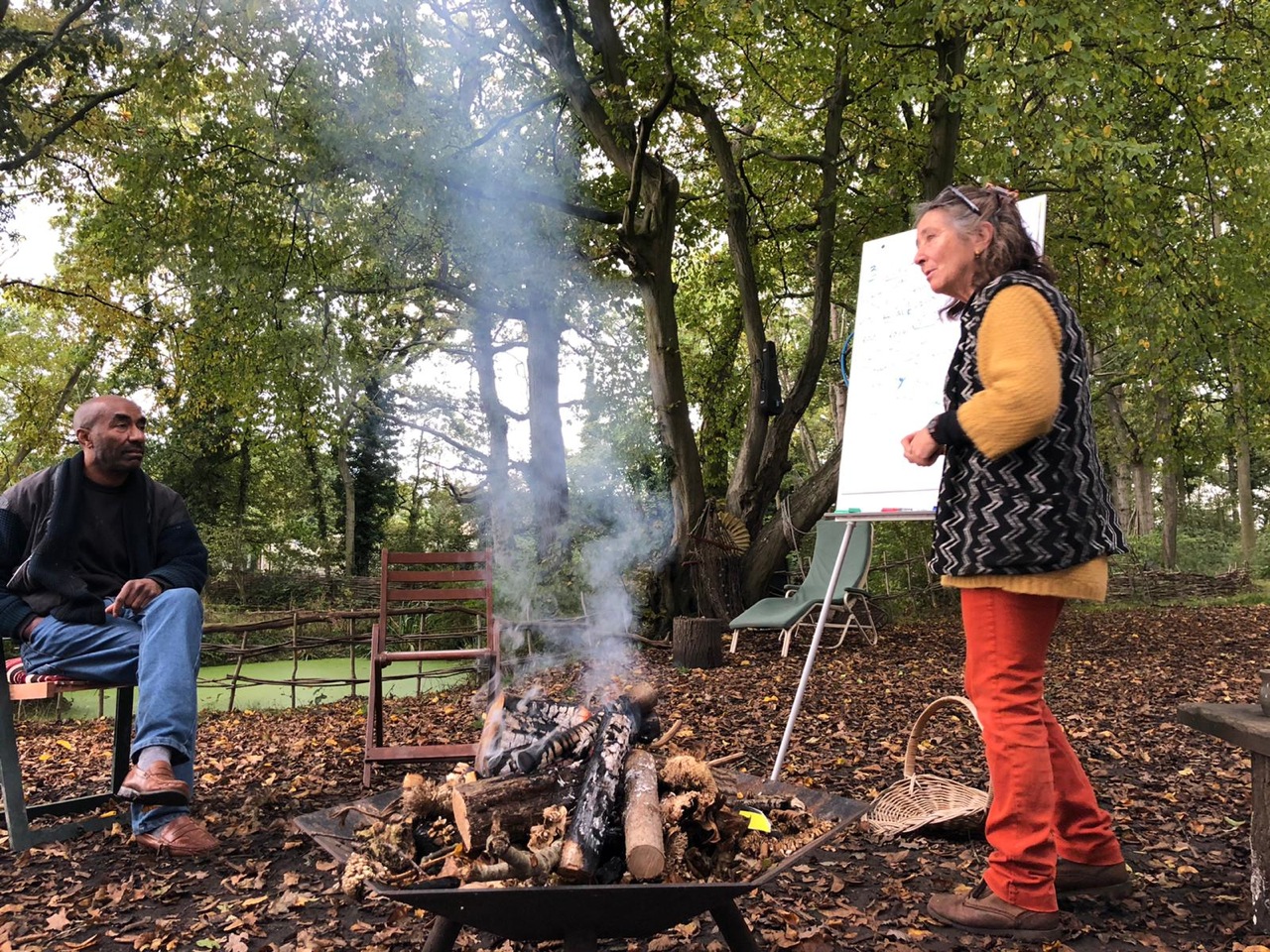
As they all gave their prepared examples, I took note of what Anna said before and did not try and find an encapsulating sentence to summarise, but rather let them.
Anna’s: I’ve not gone on his journey with him.
Michael: Humanist rift, based on personal animosity
Andrew: a cousin who did not take kindly to being told he was out of order
Alice: friend who went awol with Sai Baba / friend who rejected Alice’s marriage way of life
Joseph: friend and colleague, who asked J to betray another friend. It’s him or me.
Some fixed views and values found early on: J friendship is life, you should always be there for a friend. Anna – friendship goes in cycles.
The straight forward story became more complicated. Was the friendship a ‘true friendship’ was it coercive? unhealthy? unbalanced?
Towards the end of the first day, Joseph said: ‘Oh by the way, did I say, he only had one eye, so I would stand on his right side and be his blind eye. Yes, it was very tiring. For him.’
That evening we ate Shepherds pie, fresh from the Aga (J: yes, i’ve heard of an Aga it was in Upstaris Downstairs) and retired early to our beds.
Sunday
Definitely the night to rest, to reflect, to return with fresh eyes, does me good. On Saturday I could not find what I found on Sunday morning: the importance of the questions we asked. So I began Sunday by repeating those questions (each had one that was essential for our understanding), emphasising the core of this dialogue, of this method was to find the right question.
Michael’s: What do you miss not having Ash in your life? Nothing was the response from J
Alice: If you were to write your story again would you change anything? Yes, I’d change I am open because I now know I would have set limits.
Andrew: How would J have felt if he signed and betrayed his values? (Shame/Traitor)
With this review, with some perspective (Anna’s discussion last night invaluable once again) we moved into a new area, the area of tolerance, the area of it takes 2 to tango, the need for both parties to want to find a bridge, for if neither did, or if only one did, the crossing back to friendship was insurmountable.
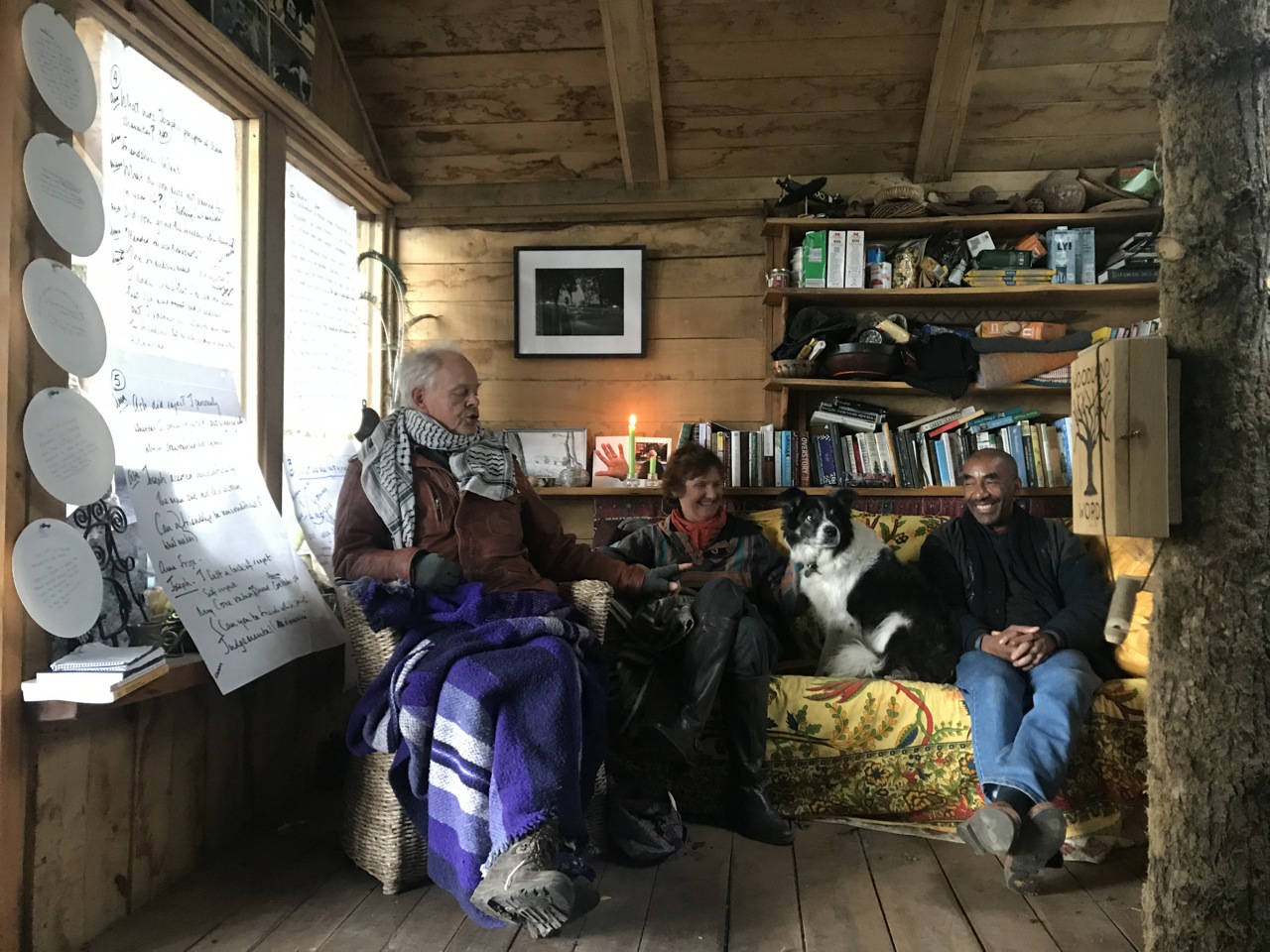
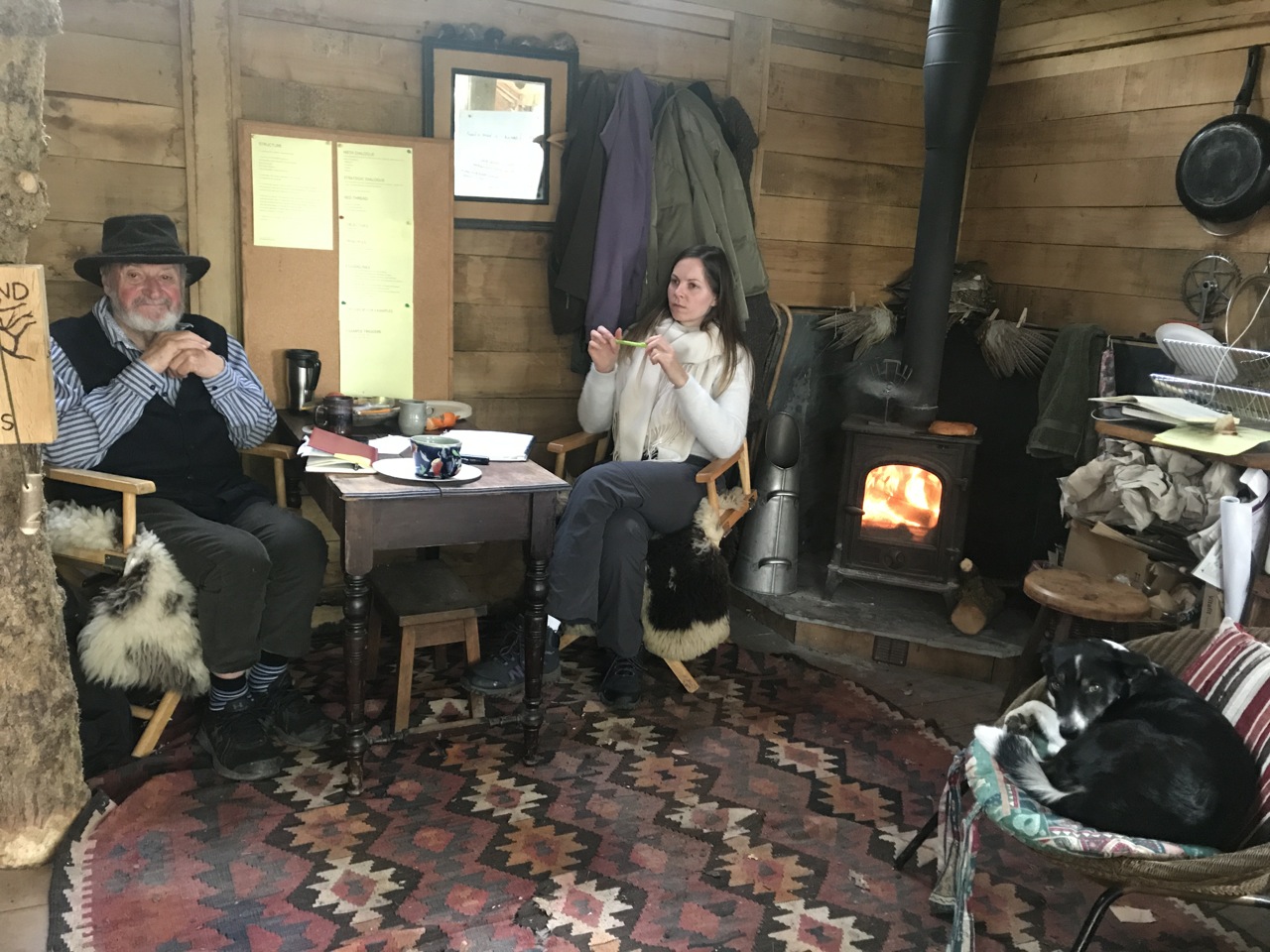
Meanwhile Anna danced on two metaphors, a breaching, like a breaching whale, both whales breaching out of the water, but then the analogy fails as they both through gravity have to go back into their medium. The other, tapping into Josephs trade, about electrical circuits, which I’ve lost the thread of now. But I was struck again by the power of metaphor, lending so much dimension to meaning.
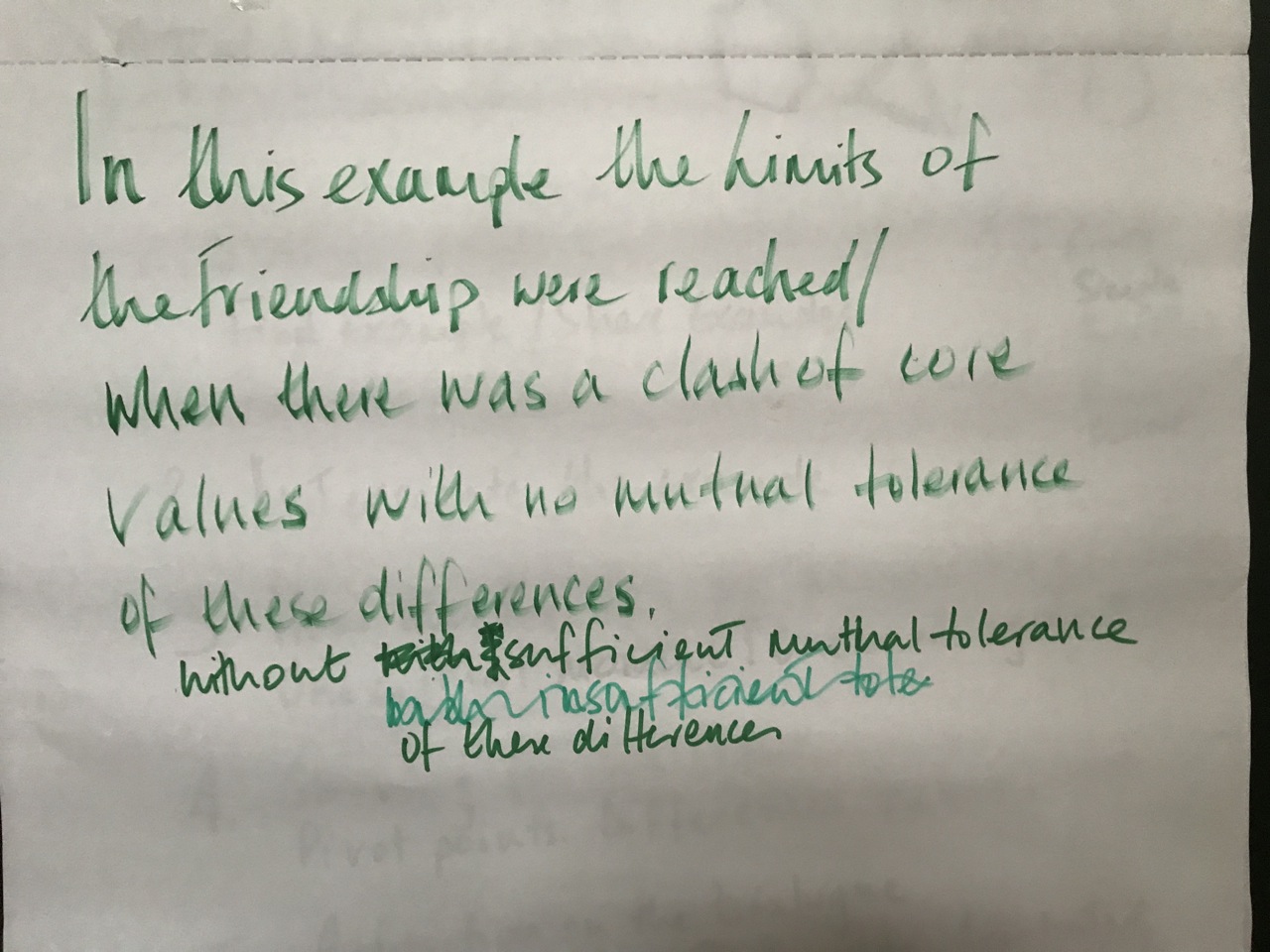
Like last time we had time to lightly open the dialogue out and apply our statement to our other examples in broad terms, and as before some fitted better than others. We had the beginnings of something. Friendship, Core Values and tolerance however, would need further investigation. Friendship – returning to what we collectively thought Friendship, in this case, was found wanting, it was imbalanced. Tolerance, I saw later, was a word we had used to describe limits. Useful to return to these our beginnings.
In our meta, here are my notes:
Joseph – I learned I do have limits
Michael – Honest example giver. No one person dominating
Alice (who that night had looked up the Polonious quote – To they own self be true…) was also impressed with the example giver, in particular his openness to shift. Fruitful was her word.
Andrew – the fresh air of questioning and allow ing doubt. Meeting peoples’s core values.
Joseph – seeing people eye to eye.
Josephs example illustrated wellthe 2nd of Dieters points: ‘I know that continuing it would be a violation of my identity by betraying my own values.’
Anna, Joseph, Michael and I walked out of the wood into the land. Out from the oaks to the light of the lane, down the track into the sandpit and finally into the field. We were in search of puff balls, and we were not disappointed. This late in the season there were two left, one better than the other, a little eaten but smelling of the earth. It was Anna’s first puff ball.
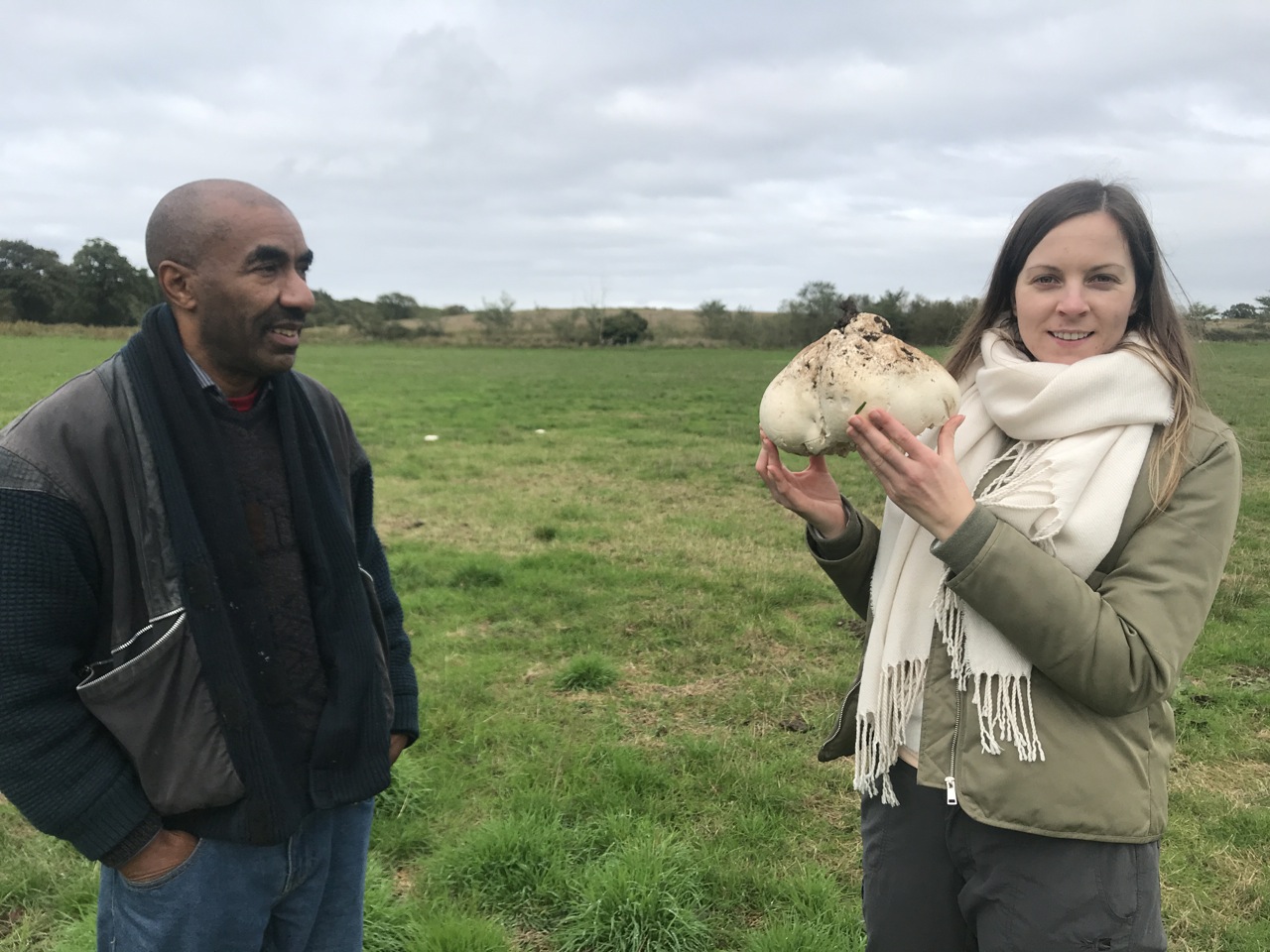

That evening we drank Conowara red wine, as M discussed the inferior quality of the coffee he has just ordered. Not up to my standards, he said ‘It is one of my core values after all’.
Later we found a very generous gift of money from Anna and Joseph.
Lessons
Writing again – getting better but oh could do so much better.
Be clear what you write – when you write. Next time invite others to write.
A hanging line for the sheets of paper.
BACKGROUND Friendship
I found this paper published in the New Yorker, entitled exactly The Limits of Friendship which challenged friendships on Social Media. As a spring board, primates have large brains because they live in socially complex societies: the larger the group, the larger the brain. Someone called Dunbar made the mental leap to humans.
The best known, a hundred and fifty, is the number of people we call casual friends—the people you’d invite to a large party. (In reality, it’s a range: a hundred at the low end and two hundred for the more social of us.) The next step down, fifty, is the number of people we call close friends—perhaps the people you’d invite to a group dinner. You see them often, but not so much that you consider them to be true intimates. Then there’s the circle of fifteen: the friends that you can turn to for sympathy when you need it, the ones you can confide in about most things. The most intimate Dunbar number, five, is your close support group. These are your best friends (and often family members). On the flipside, groups can extend to five hundred, the acquaintance level, and to fifteen hundred, the absolute limit—the people for whom you can put a name to a face. While the group sizes are relatively stable, their composition can be fluid. Your five today may not be your five next week; people drift among layers and sometimes fall out of them altogether.
Meaningful
Is it possible to have a meaningful relationship/friendship with one that has – sometimes unexpectedly – opposing views that will dramatically effect our futures?”
MIND THE GAP
Psychological – one is the emotional impossibility of continuing to feel friendship
Philosophical – ending because continuing it would be a violation of my identity by betraying my own values.
Friendship – relationship of mutual affection between people.
Aristotle figured there were three kinds of friendships:
Friendships of utility: exist between you and someone who is useful to you in some way. ...
Friendships of pleasure: exist between you and those whose company you enjoy. ...
Friendships of the good: are based on mutual respect and admiration.
In philosophical discussions of friendship, it is common to follow Aristotle (Nicomachean Ethics, Book VIII) in distinguishing three kinds of friendship: friendships of pleasure, of utility, and of virtue. Although it is a bit unclear how to understand these distinctions, the basic idea seems to be that pleasure, utility, and virtue are the reasons we have in these various kinds of relationships for loving our friend. That is, I may love my friend because of the pleasure I get out of her, or because of the ways in which she is useful to me, or because I find her to have a virtuous character. Given the involvement of love in each case, all three kinds of friendship seem to involve a concern for your friend for his sake and not for your own.
philia seems to be the kind of concern for other persons that is most relevant to friendship, and the word, ‘philia,’ sometimes gets translated as friendship; yet philia is in some ways importantly different from what we ordinarily think of as friendship. Thus, ‘philia’ extends not just to friends but also to family members, business associates, and one’s country at large.
In philosophical accounts of friendship, themes are: mutual caring (or love), intimacy, and shared activity.
According to Degges-White, there are four core types of friendship: acquaintance, friend, close friend and best friend.


This was very interesting reading Rachel.
LikeLike
Would u like to do a dialogue? November will be on zoom . X
LikeLike
That sounds really interesting Rachel. I want to do the course you did at Cambridge. Could you send details some time please? We are thinking of moving up to Suffolk – Halesworth or Beccles!! Our house in Hertfordshire is on the market!!
LikeLiked by 1 person