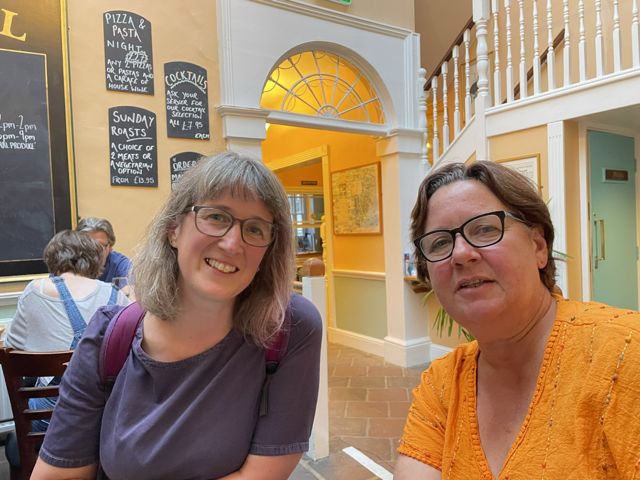
When the two Katrins said they would like to visit the wood and forests school, I said, let’s have a dialogue. (They were over from Berlin /Postdam, to celebrate Katrin’s birthday, and this was the end of a British adventure, encompassing Scotland and randomly Dunwich and it’s disappearing churches story.)
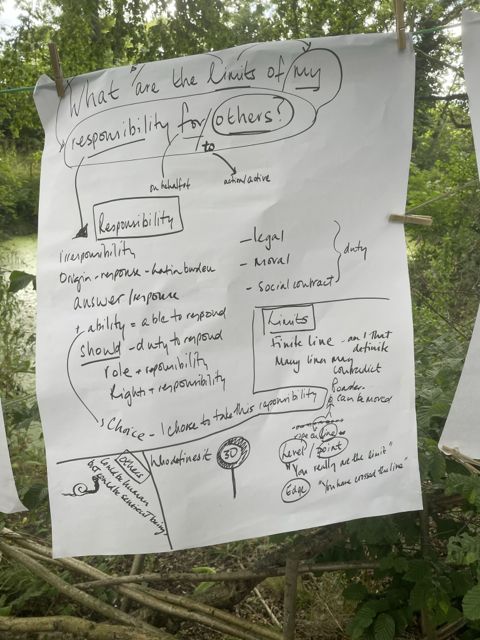
What are the limits of my responsibility for others?
As A said, the question had the burden of being long, and even the prepositions were challenging, FOR or TO (others) in particular.
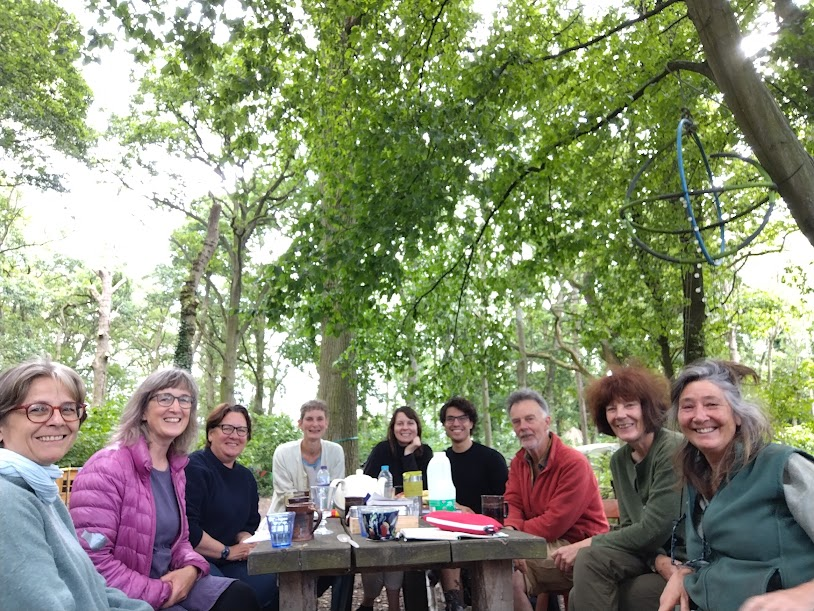
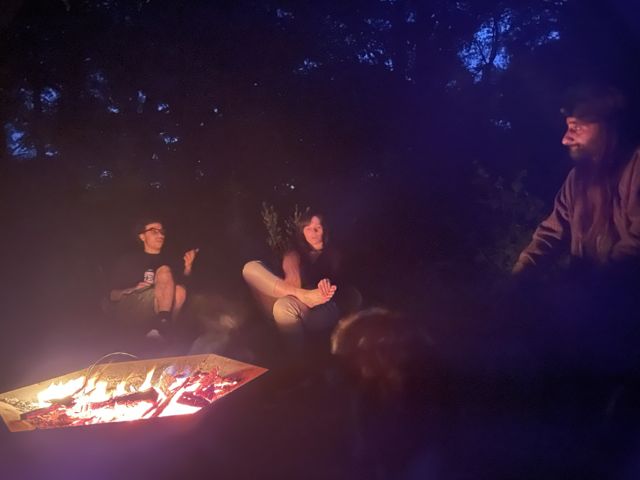
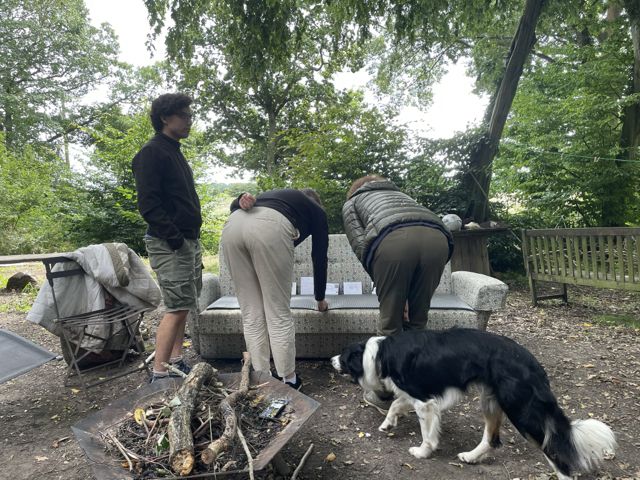
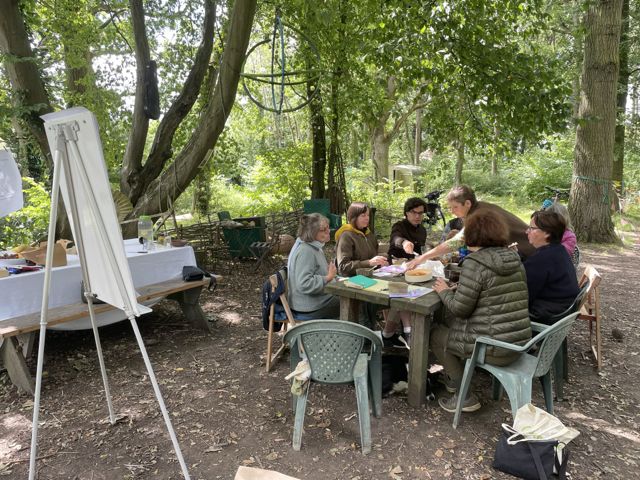
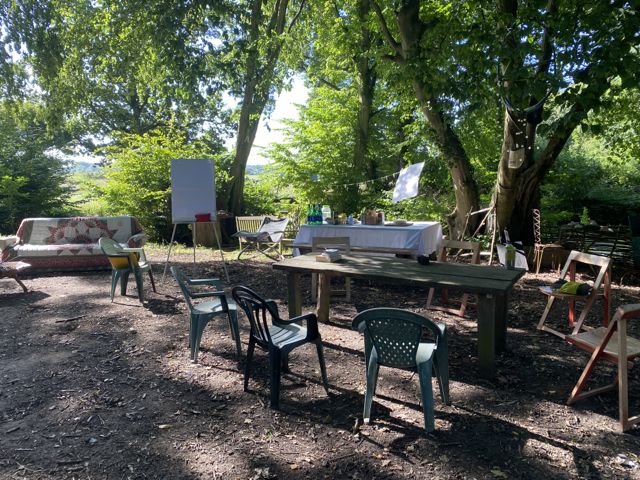
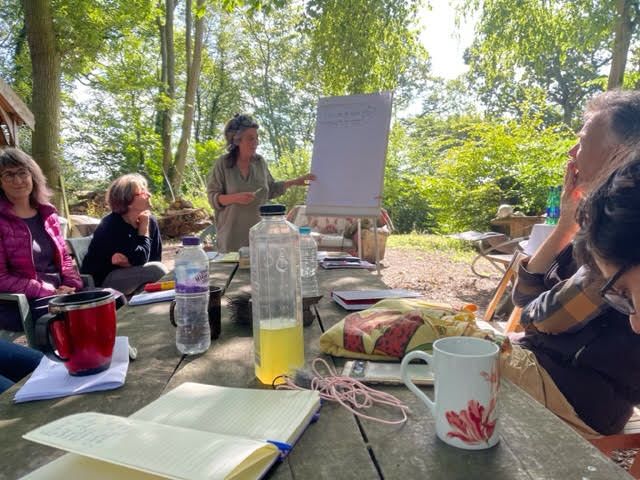
We gathered in the wood. We were a perfect mix. Friends and SFCP colleagues (to keep me on the straight and narrow), two friends who’d never done a socratic dialogue before, and a stranger, who had experience in different and similar dialogue forms.
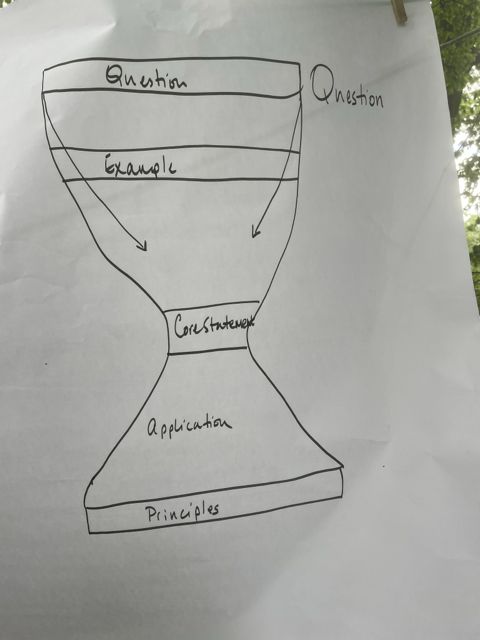
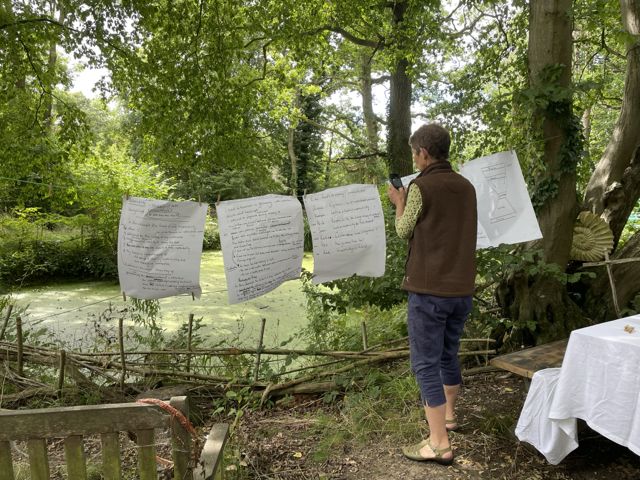
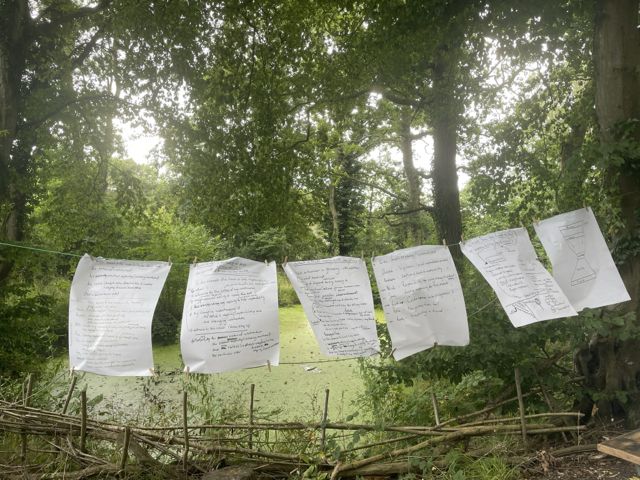
Preamble included the basis of dialogue etiquette, the form outline (using the hour glass image), before we introduced ourselves and our experience of SD.
We unpicked the question, concentrating on RESPONSIBILITY and LIMIT but surprisingly also OTHERS, which could be a snail which had taken an unexpected lift on a bicycle, but which we agreed in this case was limited to human beings. The discussion of the difference between TO and FOR (others) began, which kept rearing its head throughout the dialogue.
We all presented our example of when in our life, we felt our responsibility was limited. N’s was chosen.
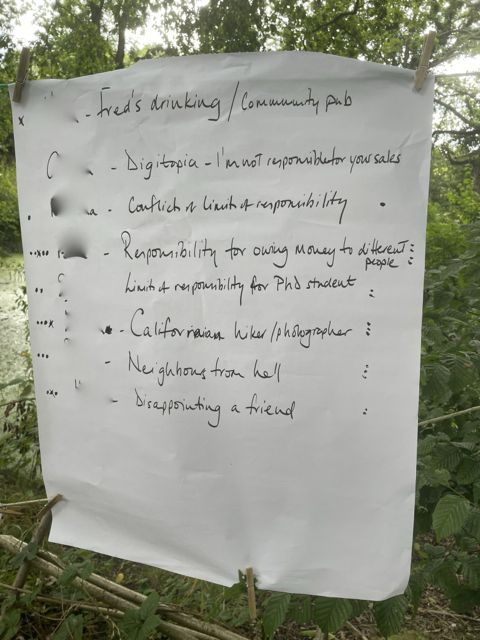
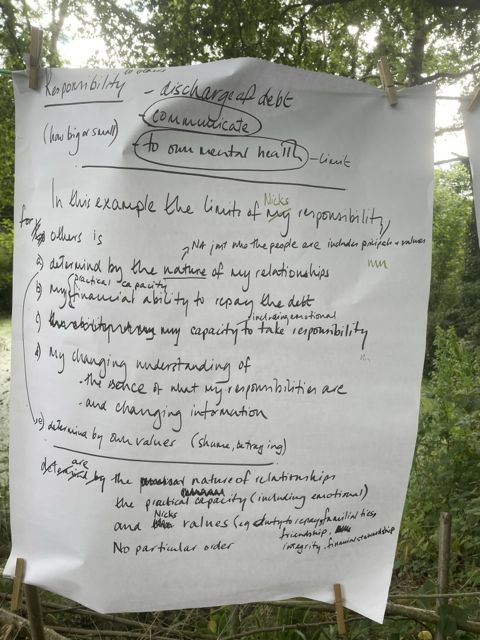
N relayed his example in more detail and it was written down, with the end statement: The limits of N’s responsibility for others was determined by
a. the nature of his relationships
b. his financial ability to repay the debt
c. His own capacity – including his emotional capacity – to take the responsibility
d. His changing understanding of the sense of what his responsibilities were and the changing information
e. his own values
Responsibilities were defined as the discharge of debt and import of communication as well as responsibility to himself for his own wellbeing.
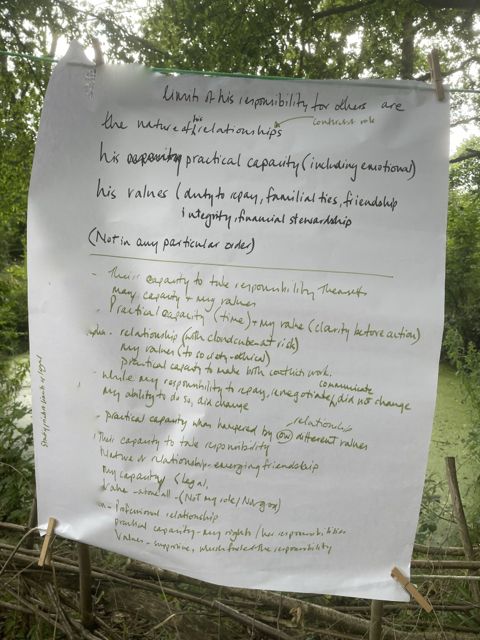
We thanked N the example giver, and together distilled these to
- The nature of his relationships
- his practical capacity (financial and emotional)
- his values (duty to repay, familial ties, friendship, integrity and financial stewardship)
In no particular order
Having found the principals in this example we looked back at our own, and found both parallels and additions.
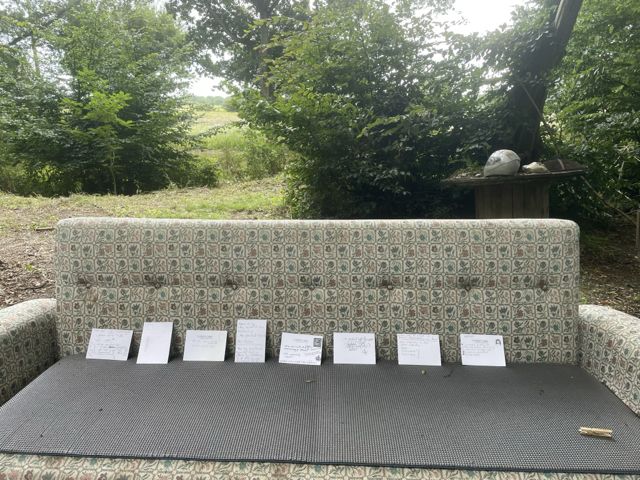
Finally we wrote on a postcard what at this stage of our inquiry, was the potential answer to this question. No time for further inquiry, as lunch and trains beckoned.
The limits of my responsibility to others are (from our postcards)
- the others capacity and my capacity (to meet the responsibility) and my values
- their own rights, their capacity, their other responsibilities (is their the person?)
- just values, their values and my values
- my practical capacity, my values (priorities), my relationship (roles) to others
- Their (the persons) values, duty, obligation. Is choice an inherent part of responsibility
- My capacity, others capacity, values, relationship. Is it unlimited?
- Based on the persons means, their relationship, and their values
- the nature of the persons relationships, the persons practical capacity and the persons values
Some reflections in my meta dialogue:
- Enjoyed spending the time drilling down
- supportive and respectful group
- exhaustive listening and processing
- How we moved forward
- Digging deeper
- How could this be applied?
- Liked the hour glass
- Unlike Springe/ we did not examine each agreement to check in – could have been more rigorous in facilitation form.
- Not convinced it depends on relationships
- Being outside gives a different dimension
- How differently we interpreted the question
- Got a bit lost yesterday afternoon
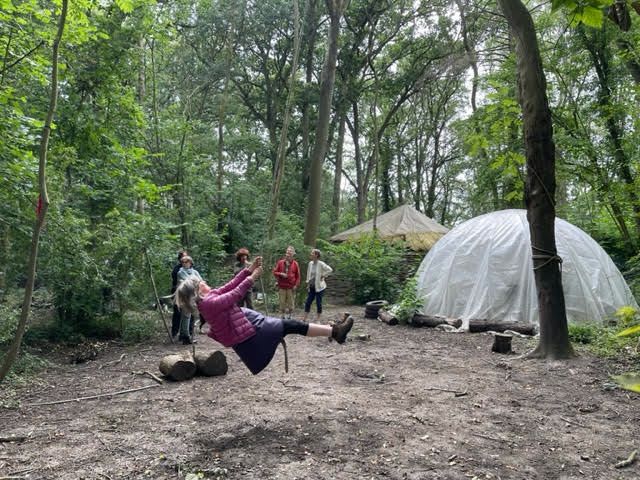
- Enjoyed the physical breaks, the Tai Chi, walk around the solar system , play on the swing. Physical freeing up.
Some unexamined avenues we went down:
- How the responsibility from the grave (eg executing a will) feels ‘higher’
- Difference between reasons and justification for reasons
- Roles and responsibilities (different from relationships)
- Legal, social and personal responsibilities
- In control and out of control of the responsibility
- how differently we would meet these same responsibilities (backer first)
- Role of shame and guilt with responsibility
- Consequences of responsibility
- Cultural differences
- Choice in the equation
- Import of values
- Sense of responsibility
Some reflections on facilitation
- I reflected at the end that my style of facilitation was ‘loose’, and like forest school, person led. For example I did not lay out all the SD rules, and limitations, but if they came up in the dialogue, illuminated them for example, not to be hypothetical or bring in outside sources.
- Benefited from the support of both S and A (“A good time to start writing up the example”.
- I could have been more rigorous with checking in at various stages. Go round each person to check in they agreed with the statements or had differences.
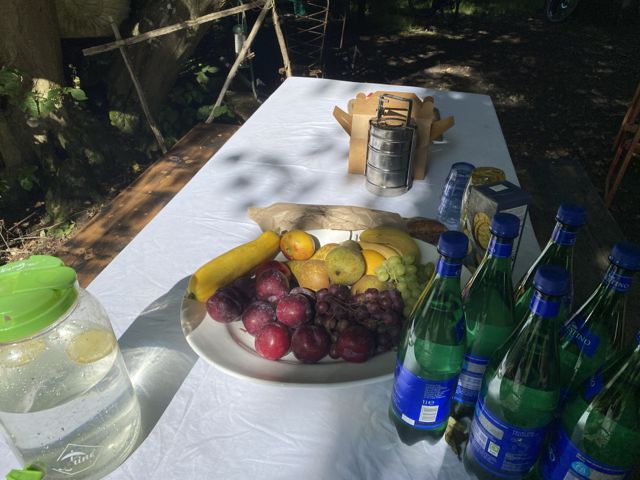
- Agree that to organise food etc as well as dialogue meant the reflection of direction and planning esp towards end of saturday suffered. (Thanks K for making the soup on Sunday)
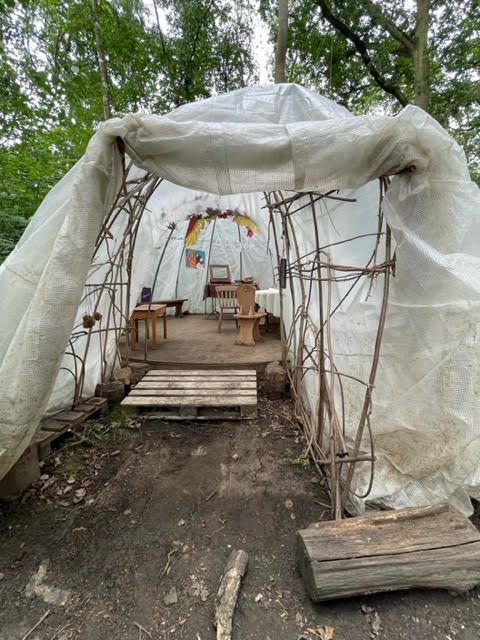
- Works well in the woods, an outside space, among trees far older than us and will exist far longer than us.
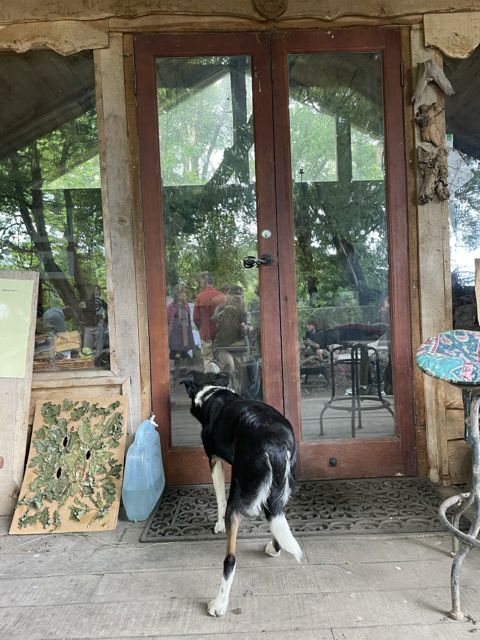
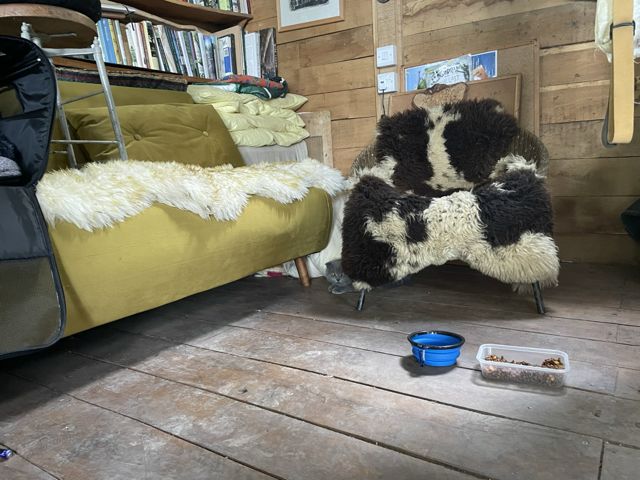
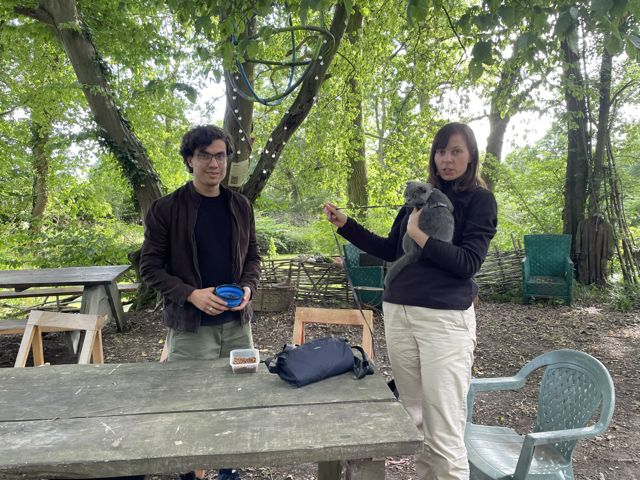
It was a great pleasure for me to share this weekend in the woods with friends and colleagues. Next time, Anna to facilitate in the woods? Dogs and Simba the cat settled iin
The words of the Little Prince come to me:
“You become responsible, forever, for what you have tamed. You’re responsible for your rose.”
Here’s a random article found on internet discussing difference between responsible to and responsible for others.



This is brilliant. I need to read it again. I am tempted to go on this Socratic dialogue course.
LikeLike
Welcome Pat. Philosophy in action is my passion, and in the woods works so well
LikeLike